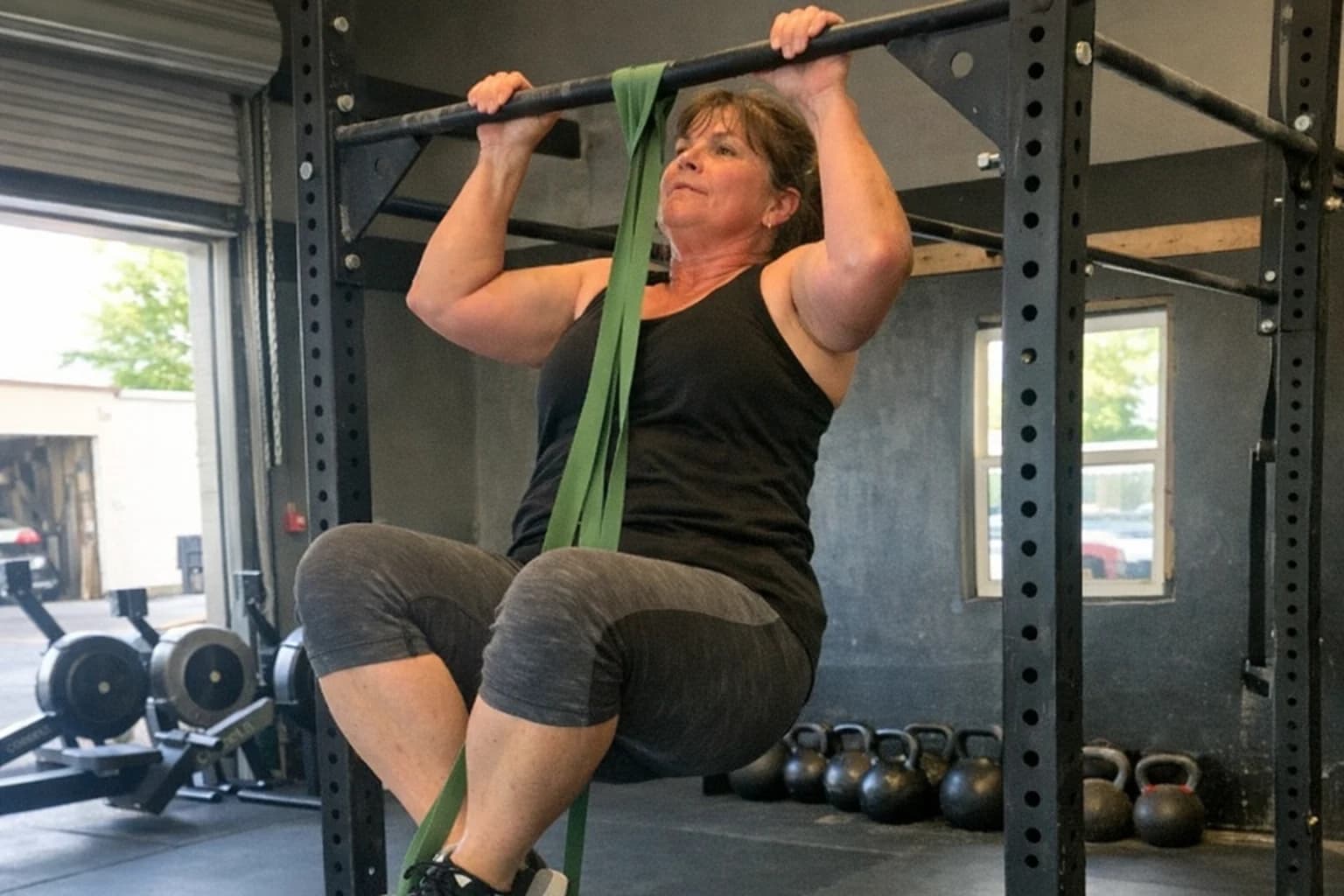
How to Get Better at Pull-Ups
Saturday, Mar 28th, 2026If you want to get better at pull-ups, here's the annoying answer first.
You do not get your first pull-up by trying random max-effort pull-ups once a week until something magical happens.
You get it by building the pieces.
Strength. Grip. Position. Consistency. A little patience.
That probably sounds less fun than some "3 pull-up hacks" reel, but it's how real people actually make progress.
And at CrossFit Aerial, real people do make progress.
Not gymnasts. Not twenty-two-year-old fitness influencers. Working parents. People in their 40s and 50s. People who haven't worked out in years. People who show up unable to hang from the bar for more than a few seconds, then a few months later they're doing ring rows, banded reps, negatives, and eventually their first real pull-up.
That's the process. Let's walk through it.
First, Know This: Most Adults Cannot Do a Pull-Up Right Away
If you can't do one yet, congratulations, you're normal.
The internet makes pull-ups look like some basic thing everyone should already have. In real life, a strict pull-up is one of the harder bodyweight movements most adults will ever try.
You're lifting your full bodyweight through space. That takes more than "wanting it." It takes actual upper-body strength, good shoulder control, a solid grip, and enough consistency to build those things over time.
So if you're starting from zero, that's not a red flag. That's just your starting point.
It's the same idea we talk about in CrossFit for Beginners and What to Expect Your First Week at CrossFit. You do not need to arrive pre-qualified. You start where you are, then build from there.
What a Good Pull-Up Actually Requires
People usually think pull-ups are just an arm exercise.
They are not.
A good pull-up depends on:
- Grip strength so you can actually stay connected to the bar
- Upper back strength especially lats and mid-back
- Shoulder stability so the movement feels controlled instead of sketchy
- Core tension so you don't swing around like a fish on a hook
- Body awareness so you can move from a dead hang into a strong pulling position
That matters, because if one of those pieces is weak, that's the piece we need to train.
Not just keep failing the full movement over and over.
The Biggest Mistake People Make
They test too often and train too little.
In other words, they jump up to the bar, fail halfway, drop off, and call that pull-up practice.
That's not practice. That's just confirming that you can't do it yet.
Actual progress comes from using movements that are hard enough to challenge you but doable enough to build strength.
At CrossFit Aerial, that usually means some version of this ladder:
- hanging and grip work
- ring rows or body rows
- scap pull-ups and active hangs
- banded pull-ups or controlled foot-assisted reps
- slow negatives
- full strict pull-ups
Not everyone moves through those steps at the same speed, and that's fine. The point is that there is a path.
Start With the Simplest Thing: Can You Hang From the Bar?
This sounds almost too basic, but it's where a lot of people should begin.
If you can't comfortably hang from a bar for 10 to 20 seconds, a full pull-up is going to feel very far away, because your grip and shoulders don't have a base yet.
So start there.
Beginner hanging progression
- passive hang for 5 to 10 seconds
- active hang for 5 to 10 seconds
- repeat for 3 to 5 sets
- build time gradually week to week
An active hang just means you're not dangling loose. You lightly pull your shoulders down and away from your ears and stay organized.
That one detail matters a lot. It teaches the shoulder position a pull-up starts from.
If hanging feels intimidating, that's normal too. Plenty of people start there. Nobody in the gym is shocked by it. If you've read CrossFit Isn't Scary, you already know the real room is a lot less dramatic than the internet version.
Ring Rows Are Not a Cop-Out
This one needs to be said plainly.
Ring rows are one of the best tools for getting your first pull-up.
Not a consolation prize. Not the fake version. A legit strength builder.
Why they work:
- you can control the angle and difficulty
- they train your back through a similar pattern
- they let you practice body tension
- they build confidence fast because you can actually do reps
If you want to improve pull-ups, get really good at rows first.
A lot of people want to skip this because rows don't look as cool. That's a mistake. Rows build the engine.
How to progress ring rows
- keep your body in a straight line
- pull the rings to your ribs or chest
- pause briefly at the top
- lower with control
- as you get stronger, move your feet farther forward to make the angle harder
If someone can knock out strong, controlled ring rows, they're usually on the right track.
Train the Top and the Lowering Phase
Most people think of a pull-up as one big up-and-down motion.
But if you can't do the whole thing yet, we can break it apart.
Two of the best pieces to train are:
1. Top holds
Use a box or step to get your chin over the bar, then hold that top position for a few seconds.
This teaches you what a strong finished pull-up feels like.
2. Negatives
Start at the top, then lower yourself as slowly as possible.
If you can take 3 to 5 seconds to lower under control, you're building real strength in exactly the right pattern.
This is money for first pull-ups.
A simple negative session might look like:
- 3 to 5 reps
- each rep starts at the top
- lower for 3 to 5 seconds
- rest between reps so each one stays controlled
Ugly flopping doesn't count. Better to do fewer quality reps.
Use Bands Carefully
Bands can help. They can also trick people.
A band makes the bottom of the movement easier, where pull-ups are usually hardest, but it can also launch people through the rep without teaching much control if the band is too thick.
So yes, banded pull-ups have a place. We use them. But the goal isn't to live there forever.
Good banded reps should still look like real reps:
- full range of motion
- shoulders active at the bottom
- no wild kicking
- controlled finish at the top
If the band is doing most of the work, go lighter or switch to another variation.
Strength Matters More Than Secret Tricks
Want to get better at pull-ups faster?
Get stronger everywhere that supports the movement.
That means training things like:
- dumbbell rows
- bent-over rows
- lat pulldowns or similar vertical pulling work
- carries for grip
- dead hangs
- hollow holds and core work
- presses and general shoulder strength
This is one reason people often get their first pull-up without obsessing over pull-ups every single day. When your whole body gets stronger, the movement gets less impossible.
That's especially true for women and for adults over 40, which is why articles like Strength Training for Women and CrossFit Over 40 matter here. Pull-ups are not about being born with some magic body type. They respond to strength training like everything else does.
Body Composition Matters, But Don't Get Weird About It
This part is true, but people handle it badly.
Yes, pull-ups are easier when you're stronger relative to your bodyweight.
No, that does not mean you need to crash diet your way to a pull-up.
For most adults, the better move is:
- build upper-body strength
- improve consistency
- eat like a normal person who wants energy and recovery
- let body composition improve as a side effect of training well
Trying to starve yourself into bodyweight movements usually backfires. You feel terrible, recover poorly, and don't build the strength you actually need.
How Often Should You Train Pull-Up Work?
Usually two or three times a week is plenty.
More is not always better, especially if your shoulders, elbows, or hands start barking at you.
A smart week might include:
- one day of rows plus hanging work
- one day of negatives or banded reps
- one day where pull-up accessories show up in regular strength work
That gives you enough practice to improve without turning your elbows into a legal complaint.
What If You Feel Pull-Ups Mostly in Your Arms?
Very common.
Usually that means one of two things:
- you're initiating by yanking with the arms instead of setting the shoulders first
- your upper back is weak enough that your arms are trying to save the whole movement
Think about pulling your shoulders down first, then driving your elbows toward your ribs.
That cue tends to clean things up fast.
And again, this is why coaching matters. A good coach can spot the issue in one set instead of letting you rehearse the wrong pattern for six months.
Pull-Ups Matter Outside the Gym Too
This isn't just about winning at bodyweight party tricks.
Pulling strength shows up in a lot of real life:
- carrying kids and gear
- handling awkward stuff overhead
- feeling more stable through the shoulders
- climbing, paddling, skiing, and hiking with less fatigue
In Duluth, that matters.
A lot of our members want to feel better on trails, during ski season, or out doing all the outdoor stuff they actually care about. That's a big reason the Duluth Outdoor Guide resonates. Gym strength is useful because it leaks into the rest of life.
How Long Does It Take to Get Your First Pull-Up?
Annoying answer number two: it depends.
It depends on your starting strength, your body size, your consistency, your age, your training history, and whether you're following a real progression or just hoping.
For some people, it might be a couple months.
For others, it might be longer.
That does not mean you're failing.
It just means a strict pull-up is a legit milestone.
And honestly, that's part of why getting your first one feels so good. You earned it.
What We Actually Do at CrossFit Aerial
We don't throw brand-new people at the pull-up bar and hope for the best.
We scale intelligently.
That means if you're not ready for strict pull-ups yet, your program might include:
- ring rows
- banded work
- hanging drills
- negatives
- dumbbell pulling work
- grip and core pieces
Then we keep building.
That's the whole coaching model. Meet people where they are, keep the standard real, and give them a path forward.
It's the same reason people who once thought they needed to "get in shape first" end up doing things they never expected. The first step is not being ready. The first step is starting.
If you want to see how that works in practice, read What to Expect Your First Week at CrossFit or see our pricing. The value is not just access to equipment. It's coaching, progression, scaling, and a room full of people who are doing the same kind of work.
The Short Version
If you want to get better at pull-ups:
- stop only testing the full movement
- build your hang first
- get strong at ring rows
- train negatives and top holds
- use bands intelligently, not forever
- strengthen your back, grip, and core
- practice two or three times a week
- stay patient long enough for the work to pay off
That's it.
No secret hack. Just a real progression.
And if you're starting from zero, you're not behind. You're just at the beginning.
That is where almost everybody starts.