CrossFit Terminology Glossary
Tuesday, Mar 24th, 2026Your first week at a CrossFit gym, the coach says something like "Today's WOD is a 15-minute AMRAP: 10 KB swings, 8 T2B, 6 DB thrusters. Scale as needed. Rx is 53/35."
And you just stand there thinking, "I understood maybe four of those words."
CrossFit has its own language. It can feel like walking into a conversation halfway through. But the terminology isn't complicated once someone explains it in plain English. So here's your cheat sheet. Bookmark this one. You'll use it. (And here's what your first week actually looks like beyond just the vocabulary.)
Workout Formats
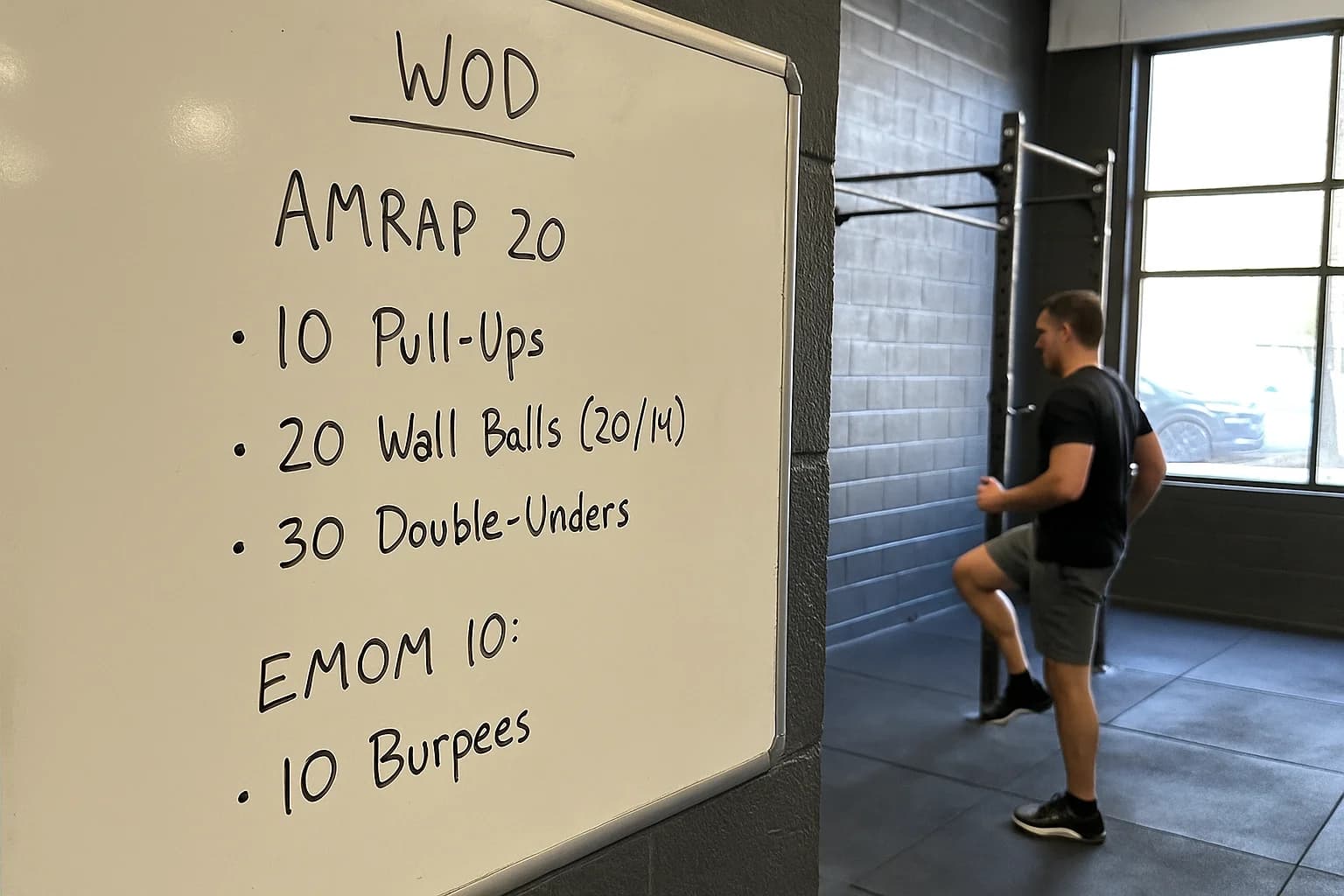
WOD stands for Workout of the Day. It's the main workout in a CrossFit class. The coach writes it on the whiteboard, explains it, and you do it. Simple as that. People sometimes use "WOD" to refer to CrossFit in general ("I did the WOD today"), which can be confusing, but it just means today's workout.
AMRAP means As Many Rounds (or Reps) As Possible. You get a set time, say 15 minutes, and a list of movements. You cycle through those movements as many times as you can before the clock runs out. Your score is total rounds and reps completed.
EMOM stands for Every Minute On the Minute. At the start of each minute, you perform a set number of reps. Whatever time is left in that minute is your rest. So if the EMOM says "5 deadlifts every minute for 10 minutes" and your 5 deadlifts take 20 seconds, you rest 40 seconds. Then go again when the next minute starts.
E2MOM (or EOMOM) is Every 2 Minutes On the Minute. Same idea, just with a two-minute window instead of one. Gives you more work and more rest per interval.
RFT means Rounds For Time. You're given a set amount of work (say, 5 rounds of 10 push-ups and 15 air squats) and your goal is to finish it as fast as possible. Your score is your total time.
For Time is the general term for any workout where you're racing the clock to finish. "21-15-9 thrusters and pull-ups for time" means you do 21 of each, then 15 of each, then 9 of each, as fast as you can.
Metcon is short for metabolic conditioning. It's the part of the workout that gets your heart rate up and keeps it there. Most WODs include a metcon component. Sometimes people use "metcon" and "WOD" interchangeably, though technically the metcon is just one piece of the class.
Chipper is a workout with a long list of different movements, done in sequence, usually for time. It's called a chipper because you're "chipping away" at a big pile of work. Example: 50 wall balls, 40 calories on the rower, 30 box jumps, 20 kettlebell swings, 10 burpees. You just grind through it.
Buy-in and Buy-out are tasks you do at the beginning or end of a workout. "Buy-in: 400m run" means you run 400 meters before starting the main workout. "Buy-out: 50 sit-ups" means you finish with 50 sit-ups after the main work is done.
Tabata is an interval format: 20 seconds of work, 10 seconds of rest, repeated for 8 rounds (4 minutes total). Named after Japanese researcher Dr. Izumi Tabata. It's short and brutal.
Scoring and Standards
Rx (pronounced "as prescribed") means doing the workout exactly as written, with the prescribed weights and movements. If the workout says 135-pound cleans and you do 135-pound cleans, you did it Rx. There's no shame in not going Rx. Most people don't, especially when they're starting out.
Scaled means you modified the workout to your ability level. Lighter weight, different movement, fewer reps. Scaling is normal and smart. Your coach will help you figure out the right scale. Katie was with us about six months before she got her first rope climb. Everything before that was scaled, and every workout was exactly what she needed.
PR stands for Personal Record. Your best performance on a given lift or workout. Hit a new back squat max? That's a PR. Finished Fran in under 5 minutes for the first time? PR. The whiteboard at any CrossFit gym has a lot of PRs circled on it.
1RM is your One Rep Max, the most weight you can lift for a single repetition of a given movement. When a program says "work up to a heavy single" or "find your 1RM back squat," this is what they mean. You'll also see percentages based on your 1RM (like "5 sets of 3 at 80% of your 1RM").
Rep is one repetition of a movement. Set is a group of reps. "3 sets of 10" means you do 10 reps, rest, do 10 more, rest, do 10 more.
Time cap is the maximum time allowed for a workout. If the workout has a 20-minute cap and you haven't finished, you stop at 20 minutes and record how far you got. Time caps exist to keep the intended intensity and make sure class stays on schedule.
Movements: Barbell
Clean is a lift that takes the barbell from the floor to the shoulders in one motion. A power clean catches the bar above parallel (you don't squat all the way down). A squat clean catches it in a full squat. The clean is one of the two Olympic lifts and it's one of the coolest movements to learn.
Snatch takes the barbell from the floor to overhead in one motion. Like the clean, it comes in power snatch (catch above parallel) and squat snatch (catch in full squat) versions. It's technically demanding and incredibly satisfying when it clicks.
Clean and Jerk is the other Olympic lift. Clean the bar to your shoulders, then jerk it overhead. The jerk can be a push jerk (dip and drive the bar up while pressing) or a split jerk (split your feet into a lunge as you drive the bar overhead).
Deadlift is picking the bar up from the floor to a standing position. It's the simplest barbell movement and one of the most useful. Rikki's deadlift PR story is a favorite at our gym.
Back Squat is a squat with the bar on your upper back. Front Squat has the bar resting on the front of your shoulders. Overhead Squat has the bar locked out overhead while you squat. That last one is a real mobility challenge.
Thruster is a front squat that goes directly into an overhead press. It combines two movements into one and it shows up in workouts constantly.
Sumo Deadlift High Pull (SDHP) is a wide-stance deadlift that finishes with pulling the bar up to chin height.
Movements: Gymnastics
Pull-up comes in two flavors in CrossFit. Strict means no swinging, just pure upper body strength. Kipping uses a rhythmic hip swing to generate momentum. Kipping isn't cheating. It's a different skill that lets you do more reps at higher intensity. Both have their place in training.
T2B (Toes to Bar) means hanging from the pull-up bar and bringing your toes up to touch the bar. It's a core and grip strength exercise. K2E (Knees to Elbows) is a scaled version where you bring your knees up instead.
C2B (Chest to Bar) is a pull-up where your chest touches the bar instead of just your chin clearing it. Requires more pull.
BMU (Bar Muscle-Up) is a pull-up that transitions over the bar so you end up in a dip position on top. Ring Muscle-Up is the same concept on gymnastics rings. These are advanced movements that most people work toward over months or years.
HSPU (Handstand Push-Up) is a push-up done upside down, usually against a wall. Your head touches the floor at the bottom, and you press back up to a full handstand.
DU (Double Under) is a jump rope skill where the rope passes under your feet twice per jump. Regular jump rope is a single under. Double-unders take practice and are one of those skills that clicks suddenly after frustrating you for weeks.
Pistol is a single-leg squat where you squat all the way down on one leg with the other leg extended in front of you. It requires strength, balance, and mobility.
Rope Climb is exactly what it sounds like. You climb a rope, usually 15 feet. There are foot-lock techniques that make it manageable, and your coach will teach you before you ever attempt one.
Equipment
KB (Kettlebell) is a cast-iron weight shaped like a cannonball with a handle. Used for swings, cleans, snatches, goblet squats, Turkish get-ups, and lots more. Common weights are 35 and 53 pounds for men, 18 and 26 pounds for women (though use whatever's appropriate for you).
DB (Dumbbell) is the familiar dumbbell. Used for all kinds of pressing, rowing, lunging, and single-arm work.
SB (Slam Ball) or Med Ball (Medicine Ball) are weighted balls. Slam balls are designed to be thrown at the ground. Medicine balls (usually 14 or 20 pounds) are used for wall balls, where you squat and throw the ball to a target on the wall.
GHD (Glute Ham Developer) is a piece of equipment used for GHD sit-ups, hip extensions, and back extensions. It looks intimidating but it's incredibly effective for core and posterior chain development.
Rig is the big metal structure with pull-up bars, J-hooks for squatting, and sometimes rings attached. It's the centerpiece of most CrossFit gyms.
Rower (Erg) is the rowing machine. Common brand is Concept2. Assault Bike (or Air Bike or Echo Bike) is a stationary bike with arm handles that gets harder the faster you go. It's universally feared and respected.
Box has two meanings. A box is slang for a CrossFit gym. A box is also the wooden or foam platform used for box jumps and box step-ups. Context makes it clear.
Plates are the weights that go on a barbell. Bumper plates are rubber-coated plates designed to be dropped from overhead, which is why CrossFit gyms are louder than regular gyms.
Other Terms You'll Hear
The Girls are benchmark workouts named after women (like hurricanes). Fran, Grace, Helen, Diane, Annie. They're standardized workouts used to measure progress over time. If someone says "I did Fran today," they mean 21-15-9 thrusters and pull-ups.
Hero WODs are workouts named after fallen military, law enforcement, and first responders. They tend to be longer and harder than normal workouts. Murph (1 mile run, 100 pull-ups, 200 push-ups, 300 squats, 1 mile run) is the most well-known.
The Open is CrossFit's annual worldwide competition. For three weeks, everyone does the same workouts and submits scores. Most people do it for fun and community, not to qualify for anything. It's a good benchmark.
Warm-up at a CrossFit gym isn't 5 minutes on a bike. It's coach-led movement prep that prepares you for that day's specific workout. If you're squatting, the warm-up includes squat-specific mobility and light reps.
Cool-down is the stretching and recovery work after the workout. Some gyms are better about this than others. It matters more than most people think.
Coach's count means the coach is counting your reps (usually in a competitive setting). If they're counting, their number is what counts, even if you think you did more.
Now Go Use This Stuff
You don't need to memorize all of this before your first class. You'll pick it up naturally as you go. Your coach will explain everything as it comes up, and nobody expects you to walk in knowing what a snatch is on day one.
But having this reference helps. Next time you see a workout posted on your gym's Instagram and it looks like alphabet soup, come back here and decode it. Pretty soon you'll be the one explaining it to the new person.
Ready to learn these words the fun way? Here's what your first week at CrossFit Aerial looks like. Already curious about what it costs?
What does WOD mean in CrossFit?
WOD stands for Workout of the Day. It's the main workout performed in a CrossFit class, written on the whiteboard by the coach. The WOD changes daily, which is part of what makes CrossFit's constantly varied programming effective. People sometimes use WOD casually to refer to any CrossFit workout.
What does AMRAP mean in CrossFit?
AMRAP stands for As Many Rounds (or Reps) As Possible. In an AMRAP workout, you're given a set time limit and a list of exercises. You cycle through the exercises as many times as you can before time runs out. Your score is the total number of rounds and extra reps completed.
What does Rx mean in CrossFit?
Rx (pronounced as prescribed) means completing the workout exactly as written, with the specified weights and movements. Going Rx is a goal for many athletes but is not expected or necessary, especially for newer members. Scaling workouts to your ability is normal and encouraged by coaches.
What is the difference between kipping and strict pull-ups?
Strict pull-ups use only upper body strength with no body swing. Kipping pull-ups use a coordinated hip swing to generate momentum, allowing more reps at higher intensity. Both are legitimate skills used in CrossFit. Strict pull-ups build raw strength while kipping pull-ups are used in metabolic conditioning workouts where volume and speed are the goal.
What are benchmark workouts in CrossFit?
Benchmark workouts are standardized workouts used to measure fitness progress over time. The Girls are named after women (Fran, Grace, Helen, Diane, Annie) and are short, intense tests. Hero WODs are named after fallen military and first responders and tend to be longer and more challenging. Repeating these workouts periodically lets you see measurable improvement.
Do I need to know CrossFit terminology before my first class?
No. Coaches explain everything during class and don't expect new members to know the terminology. You'll pick up the vocabulary naturally as you attend classes. Having a glossary reference can help when you see workouts posted on social media or want to understand what's coming up, but it's not a prerequisite for starting.