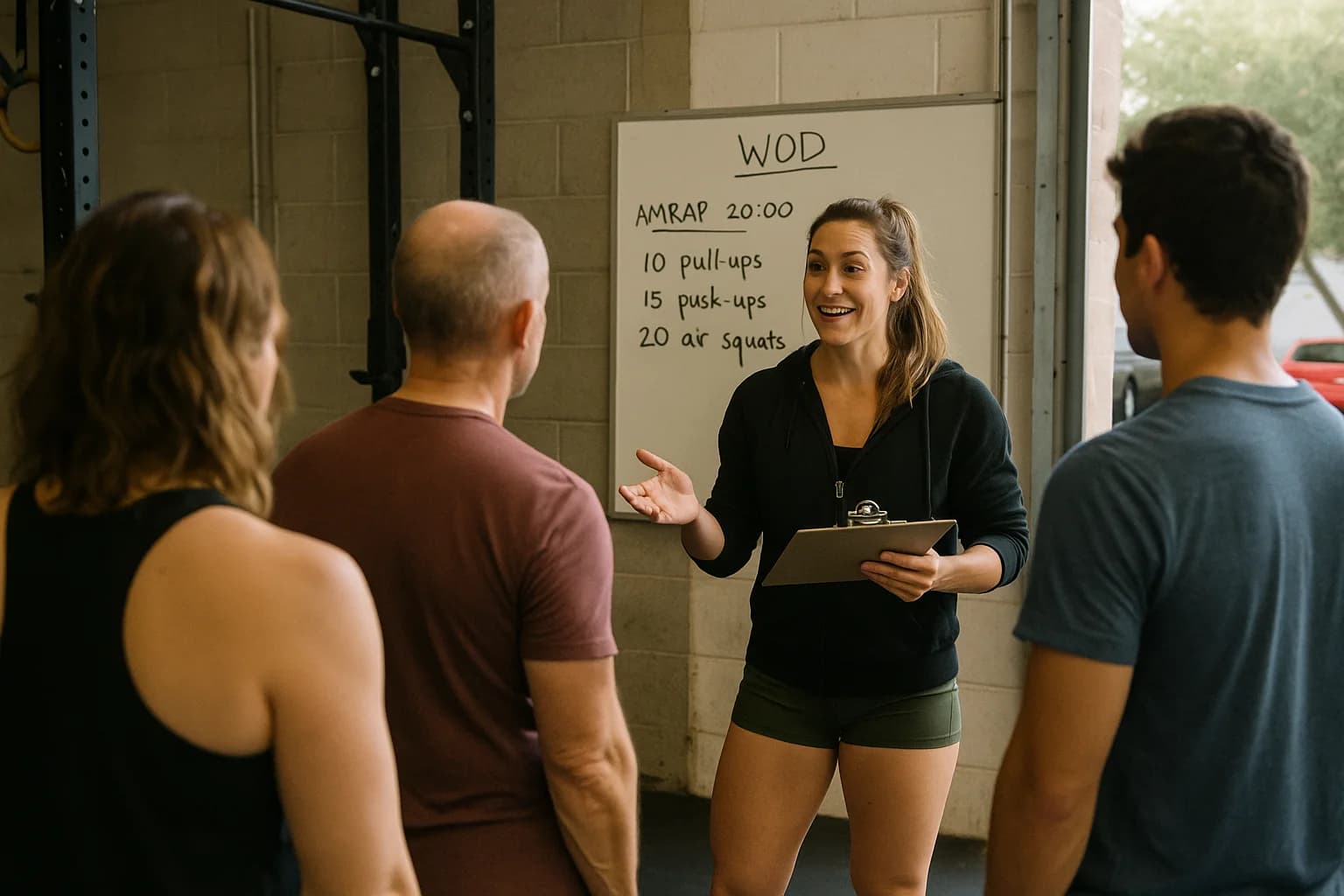
What Does a CrossFit Coach Do
Tuesday, Mar 24th, 2026You've probably had the experience. You sign up at a gym, someone gives you a quick tour, maybe shows you how to adjust the seat on the leg press, and then they vanish. You're on your own. You wander between machines, do some curls, hop on the treadmill for 20 minutes, and go home wondering if you accomplished anything.
A CrossFit coach is a completely different thing. And understanding what they actually do helps explain why CrossFit costs more than a $10/month card-swipe gym membership.
They Write the Programming
Your CrossFit workout isn't random. It's not pulled from a hat or generated by an algorithm. A coach (or team of coaches) writes the programming with intention.
That means there's a reason Monday was heavy squats and Tuesday is a fast conditioning piece. There's a reason you're seeing pulling movements this week and pressing movements next week. The programming accounts for strength development, conditioning, skill work, and recovery in a way that builds over weeks and months.
At CrossFit Aerial, our coaches design programming based on what our members need. We know who's training for a hiking trip. We know who's rehabbing a shoulder. We know who's been coming three days a week versus five. That context shapes what goes on the whiteboard.
Compare this to a globo gym where you're guessing. Or to a group fitness class where the template comes from a corporate office and gets applied to every location regardless of who walks in the door. There's a real difference.
They Assess How You Move
Before you ever touch a barbell at a good CrossFit gym, a coach watches you move. Can you squat to full depth? How's your overhead position? Any pain or limitations you're working around?
This isn't a formality. This assessment determines how your coach scales workouts for you from day one. If your overhead mobility is limited, they're not going to have you snatching heavy on your first week. If your knees cave in on squats, they'll address that before adding weight.
Dave, one of our members, told us when he started that he just wanted someone to tell him what to do. He was retired, hadn't exercised consistently in years, and was tired of guessing. His coaches assessed where he was, built a plan to get him moving safely, and progressed him from there. A year later, he's stronger than he's been in decades. That started with someone watching him move and making smart decisions about his training.
They Coach in Real Time
This is the part that matters most, and it's the hardest thing to see from the outside until you experience it.
During a workout, your coach is watching. Not standing at the front checking their phone or just counting down reps. Actually watching. They're scanning the room for movement quality, pacing, and safety.
When your deadlift form starts to slip because you're fatigued, they'll cue you. "Drive through the heels." "Chest up." Sometimes it's a verbal cue, sometimes they'll physically guide the bar path. These corrections happen in real time, while you're moving, and they prevent injuries before they happen.
This is wildly different from watching a YouTube video on how to deadlift and hoping you're doing it right. Even experienced lifters benefit from having external eyes on their movement. You can't always feel what you look like.
They Scale the Workout to You
Scaling is maybe the most misunderstood part of CrossFit. People assume it means "the easy version." It's actually the smart version.
When the workout calls for 21-15-9 thrusters and pull-ups, a good coach has already thought about how that workout should look for each person in the room. The 28-year-old former collegiate athlete might do it as written. The person who started three months ago might use a lighter barbell and ring rows. The person with a shoulder issue might do dumbbell push presses and lat pulldowns instead.
Same workout. Same intent. Different execution based on where you are right now. Your coach makes those decisions for you, which is why they need to know your history, your current ability, and your limitations.
Shari started in our bootcamp program before transitioning to regular CrossFit classes. Her coaches scaled her appropriately the entire way, gradually increasing complexity as she got stronger and more confident. By winter she was shoveling her driveway and feeling strong doing it. That progression was deliberate.
They Track Your Progress
Good coaches remember what you lifted last week. They know your back squat max, your Fran time, and whether you've been dealing with a tight hip. When you walk in, they have context.
This means they can help you set appropriate weights for the day's workout. They can push you when you're sandbagging and hold you back when you're going too hot. They notice when you're having an off day and adjust expectations accordingly.
Rikki works a desk job and is in her 40s. Her coaches knew her movement history, her strength progression, and her goals. When she hit a deadlift PR, it wasn't an accident. It was the result of months of intentional programming and coaching that her coaches managed. They knew she was ready for that attempt because they'd been watching her build toward it.
They Hold You Accountable
This is the thing nobody talks about when discussing what you're paying for at a CrossFit gym.
Your coach notices when you don't show up. Not in a guilt-trip way, but in a "hey, we missed you this week, everything okay?" way. That simple check-in is worth more than any fitness app notification.
Lars trained alone for years. He was a capable athlete, knew how to program for himself, and had the knowledge to train effectively. But he lost motivation. Training alone, even when you know what to do, is lonely. He came back to CrossFit specifically because he needed coaches and a community that noticed when he was there and when he wasn't. That accountability changes everything.
Your coach also holds you accountable to standards. Not in a drill-sergeant way, but in a "I know you can do better than that" way. They've seen what you're capable of and they won't let you coast. They also won't let you push past what's safe. It's a balance, and good coaches walk that line every class.
They Educate You
Over time, a good CrossFit coach teaches you about your own body. Why your ankles are tight and how that affects your squat. Why your shoulders need warm-up work before overhead pressing. How to breathe during a heavy lift. What signs of overtraining look like.
You won't learn this from a poster on the wall or a machine with a diagram on it. You learn it from a person who knows your body, watches you move regularly, and takes the time to explain things when they see an opportunity.
This education compounds. After a year of CrossFit with good coaching, you understand biomechanics in a way that makes you smarter about movement for the rest of your life. You know how to pick up a heavy box from the floor. You know how to brace your core. You know the difference between good pain and bad pain. That knowledge has value far beyond the gym.
They Build the Culture
A gym's culture starts with its coaches. If coaches celebrate effort, consistency, and smart training, that's what the membership values. If coaches celebrate going heavy at all costs, you get a different (worse) culture.
At CrossFit Aerial, our coaches cheer for the person finishing last just as loud as the person finishing first. They celebrate the member who scaled appropriately and got a great workout. They set the tone for every class, and that tone determines whether new members feel welcome or intimidated. (That matters more than you might think.)
This isn't something you can quantify on a comparison spreadsheet, but it's one of the biggest reasons people stay at a gym or leave. When you walk in and the coach greets you by name, asks about your weekend, and knows that you tweaked your knee last Thursday, you feel taken care of. That's not an accident. That's coaching.
What You're Actually Paying For
When people compare CrossFit's price to a $30/month gym membership, they're comparing two completely different products. A gym membership gives you access to equipment. A CrossFit membership gives you a coach who writes your programming, watches your movement, scales your workouts, tracks your progress, holds you accountable, educates you about your body, and builds a community around you.
That's not a gym membership. That's concierge fitness. And when you look at what people pay for personal training at a traditional gym ($60-100 per session), the per-class cost of CrossFit with that level of attention is a fraction of the price.
Here's what it actually costs. And here's what walking in on day one looks like.
What qualifications do CrossFit coaches have?
CrossFit coaches hold a CrossFit Level 1 Certificate at minimum, with many holding Level 2 or Level 3 certifications. Good coaches also pursue additional education in areas like Olympic weightlifting, gymnastics, nutrition, and mobility. At CrossFit Aerial, our coaches have years of coaching experience and continue their education to stay current with best practices.
How is a CrossFit coach different from a personal trainer?
A CrossFit coach manages a group class while providing individualized attention through scaling and real-time movement correction. Personal trainers work one-on-one but at a much higher per-session cost. CrossFit coaches combine the benefits of group energy and accountability with personalized coaching at a fraction of the cost of private training. They also program workouts for the entire group, balancing the needs of multiple fitness levels in every class.
Do CrossFit coaches create the daily workouts?
At most CrossFit affiliates, coaches are involved in programming or select programming that fits their membership's needs. At CrossFit Aerial, programming is designed with our specific members in mind. Workouts are sequenced intentionally across days and weeks to develop strength, conditioning, and skills while managing recovery. This is different from template-based group fitness where workouts are created at a corporate level.
Will a CrossFit coach correct my form during class?
Yes, real-time form correction is one of the most important things a CrossFit coach does. During every workout, coaches actively watch members and provide verbal cues or physical guidance to maintain safe and effective movement. This is why CrossFit gyms keep class sizes manageable, so coaches can actually see everyone and intervene when needed.
What does scaling mean in CrossFit?
Scaling means modifying a workout to match your current fitness level while maintaining the intended stimulus. A coach might reduce weight, change the movement to a simpler variation, or adjust the number of reps. Scaling is not the easy version. It is the smart version that lets everyone from beginners to advanced athletes get an appropriate workout in the same class.