How CrossFit Fixes Your Desk Job Body
Tuesday, Mar 24th, 2026Your body was not designed to sit in a chair for eight hours. Nobody's was. But that's what most of us do, five days a week, year after year. And then we wonder why our backs ache, our hips feel like they've rusted shut, and our shoulders are slowly migrating toward our ears.
If you work at a desk, you already know the damage. Maybe you've tried the standing desk thing. Maybe you bought a fancy ergonomic chair. Maybe you do a few stretches in the morning that you saw on Instagram. And maybe none of it has really fixed the problem.
Here's why: you can't out-stretch eight hours of sitting. You need to build the strength your desk job is slowly stealing from you. That's where CrossFit comes in.
What Sitting Actually Does to Your Body
Let's talk about what's happening under the surface. When you sit for extended periods, a few things go wrong. Not overnight, but gradually, compounding over months and years.
Your hip flexors shorten. These muscles connect your thighs to your pelvis, and when you sit, they stay in a shortened position all day. Over time, they tighten up and start pulling your pelvis forward. That forward tilt is a major contributor to lower back pain.
Your glutes stop firing properly. When you sit, your glutes do nothing. They just hang out. And muscles that don't get used start to forget how to work. This is sometimes called "gluteal amnesia," which sounds made up but is a real problem. Weak glutes mean your lower back picks up the slack, which means more pain.
Your shoulders round forward. You're reaching toward a keyboard all day. Your chest muscles tighten. Your upper back weakens. Your head drifts forward. If you've ever caught your reflection in a window and thought "I look like a question mark," this is why.
Your thoracic spine stiffens. The middle part of your back is supposed to rotate and extend. Sitting locks it in one position for hours. This stiffness contributes to neck pain, shoulder issues, and the general feeling that you can't fully twist or reach overhead anymore.
How CrossFit Specifically Counters Desk Damage
This isn't about getting a six-pack. This is about undoing the physical damage of your job. CrossFit includes movements that directly target every problem sitting creates. Here's how they match up:
Deadlifts rebuild your posterior chain. Your posterior chain is everything on the back side of your body: glutes, hamstrings, lower back, upper back. These are exactly the muscles that weaken from sitting. Deadlifts teach them to fire again, and they make your entire backside strong. Lower back pain from sitting often improves dramatically once your glutes and hamstrings are actually doing their job.
Squats open up your hip flexors. A full-depth squat takes your hips through a range of motion they never see at a desk. Over time, squatting regularly counteracts the tightness that sitting creates. Your hip flexors get lengthened under load. Your glutes learn to activate at the bottom of the movement. It's the antidote to a chair.
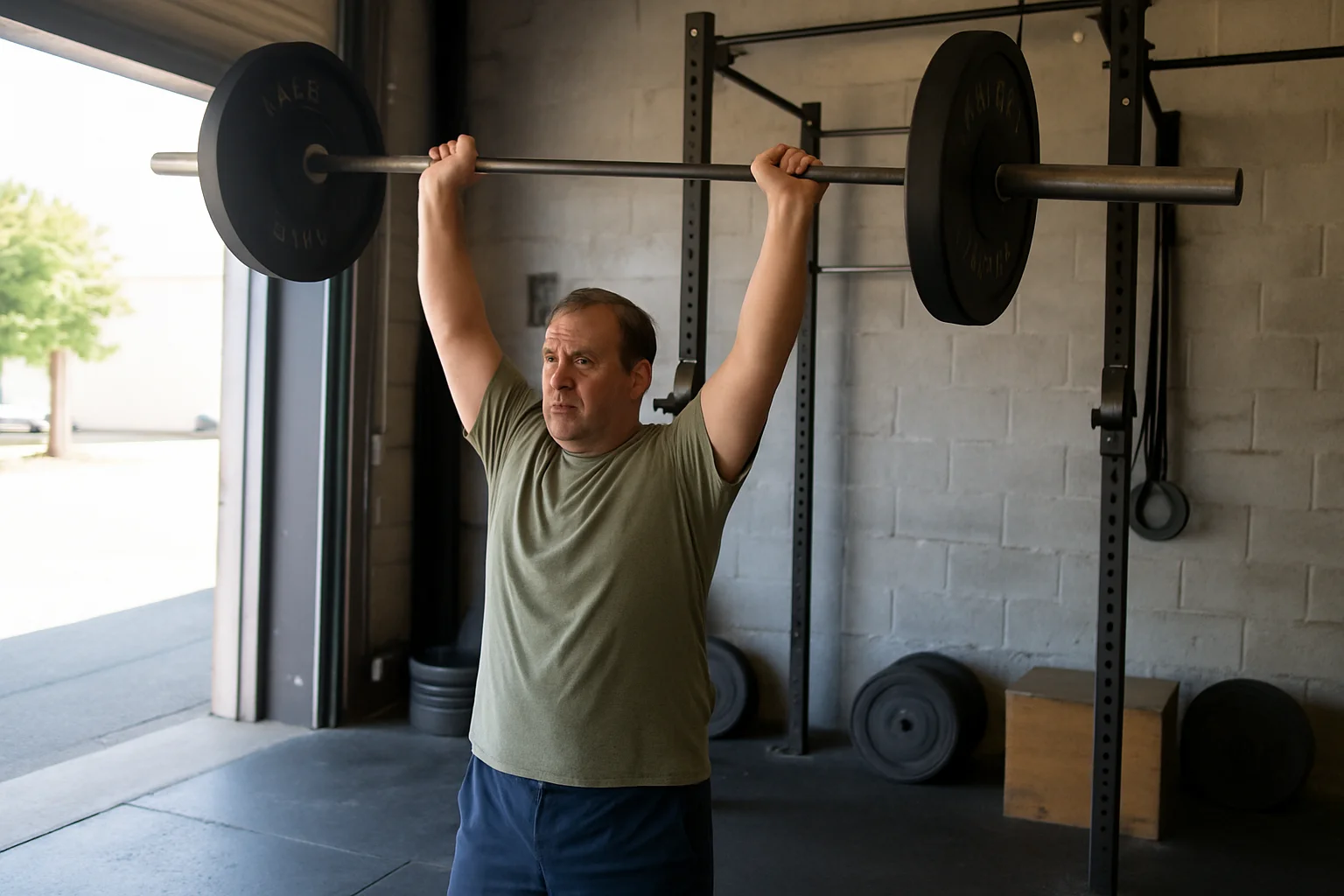
Overhead press fixes your shoulders. Pressing a barbell or dumbbell overhead forces your shoulders into full extension, which is the opposite of where they sit all day. It strengthens the muscles of your upper back and shoulders that get weak from hunching. If you can't raise your arms fully overhead without arching your back, overhead pressing will slowly restore that mobility.
Rowing corrects your posture. Whether it's a barbell row, a dumbbell row, or a rowing machine, pulling movements strengthen your mid and upper back. These are the muscles responsible for pulling your shoulders back and keeping you upright. Desk workers almost always have underdeveloped pulling muscles relative to their pushing muscles. CrossFit programs rowing and pulling heavily.
Carries build functional core strength. Farmer's carries, overhead carries, front rack carries. Walking with heavy stuff. These train your core to stabilize your spine while you're moving, which is what your core is actually supposed to do. Way more useful than crunches.
Rikki's Story
Rikki spent years at a desk job in her 40s. The typical experience: tight everything, low energy, back pain that was just background noise in her life. She wasn't looking to become an athlete. She was looking to stop feeling terrible.
When she started at CrossFit Aerial, the movements were hard. Not because the weights were heavy, but because years of sitting had made basic movements difficult. Squatting to full depth was a challenge. Reaching overhead felt restricted.
She stuck with it. The coaches scaled everything to her level and progressed her gradually. Within a few months, things started changing. Her back stopped hurting. Her posture improved. She had energy after work instead of collapsing on the couch.
And then something unexpected happened. She started hitting deadlift PRs. Real, significant strength gains. The woman who came in barely able to squat to a box was now pulling weight she never thought possible. The desk job was still there. But it no longer had the final say over her body.
The Standing Desk Isn't Enough
Standing desks are fine. They're better than sitting all day, sure. But standing in one position for eight hours creates its own set of problems. And a standing desk doesn't build any strength. It just changes the position you're weak in.
The same goes for ergonomic chairs, posture correctors, and all the gadgets designed to make sitting less destructive. They mitigate the damage. They don't fix it.
The fix is building the strength and mobility that sitting takes away. There's no shortcut for that. You have to actually train the muscles that are shutting down.
Practical Stuff You Can Do Today
While you're building strength at the gym, there are a few things you can do at work to help:
Get up every hour. Set a timer if you have to. Stand, walk to the water cooler, go to the bathroom, do something that breaks the position. Even two minutes of movement helps reset your muscles.
Do some hip flexor stretches at your desk. One foot forward, one knee on the ground (or a couch cushion if you're at home). Lean forward gently. Thirty seconds each side. It won't undo years of sitting, but it keeps things from getting worse.
Check your monitor height. Your eyes should be level with the top third of your screen. If you're looking down all day, your neck is taking a beating.
But know that these are band-aids. The real solution is in the gym. An hour of structured training three to five times a week will do more for your desk-damaged body than any office gadget. Consistent exercise is the intervention that actually works.
Why CrossFit and Not Just a Regular Gym
You could go to a regular gym and do these movements on your own. In theory. In practice, most people with desk jobs don't know what to do, do the wrong things, or lose motivation within a few weeks.
At a CrossFit gym, the programming is done for you. You don't need to design your own workout. Every class includes the pulling, squatting, pressing, and core work your body needs. The coach watches your form, which matters a lot when you're dealing with tight muscles and limited mobility. Doing a deadlift wrong when your back is already compromised is a bad idea. Having someone make sure you're doing it right is the difference between getting stronger and getting injured.
The structure and coaching remove the guesswork. You walk in, someone competent tells you what to do, they make sure you do it correctly, and you leave stronger than you came in.
It Doesn't Take Long to Feel the Difference
Most desk workers who start CrossFit notice changes within the first month. Better sleep is usually the first thing. Then the back pain starts to fade. Then you realize you're sitting up straighter without thinking about it.
By three months, the difference is usually obvious. Your body feels younger. Movements that used to be stiff are easier. You can reach things on high shelves without grimacing. You can sit on the floor and get back up without making noises.
By six months, people at work start asking what you're doing. Not because you look dramatically different (though you might), but because you carry yourself differently. Your posture changes how people perceive you before you say a word.
Your Desk Job Doesn't Have to Win
You probably can't quit your desk job. The mortgage isn't going to pay itself. But you can stop letting it dictate the condition of your body.
An hour of training, a few times a week. That's the countermeasure. It builds back the strength sitting steals. It opens up the mobility that gets locked down. It gives your body a reason to be more than a chair-shaped object.
If your back hurts, your hips are tight, and you feel ten years older than you are, it's not because you're getting old. It's because you're sitting still. And the solution is to stop.
Not sure where to start? Here's what beginners can expect, and here's an honest look at what it costs. Your body will thank you.
Can CrossFit help with back pain from sitting at a desk?
Yes. Much of the lower back pain from desk jobs is caused by weak glutes and hamstrings, tight hip flexors, and a deactivated posterior chain. CrossFit movements like deadlifts, squats, and rows directly strengthen these areas. Many members report significant improvement in back pain within the first few months of consistent training. However, if you have a specific injury, consult with a medical professional before starting any program.
What CrossFit movements are best for desk workers?
Deadlifts strengthen the posterior chain that weakens from sitting. Squats open tight hip flexors and activate dormant glutes. Overhead presses restore shoulder mobility lost from hunching. Rowing movements strengthen the upper back to improve posture. Carries build functional core stability. A well-programmed CrossFit class includes all of these movements regularly.
How quickly will I notice improvement in my posture from CrossFit?
Most people notice initial improvements within the first month, starting with better sleep and reduced stiffness. By two to three months, back pain typically decreases and posture visibly improves. By six months, the changes are usually obvious to others. Consistency matters more than intensity, with three to five sessions per week producing the best results.
Is a standing desk enough to fix desk job posture problems?
Standing desks are better than sitting all day, but they don't solve the underlying problem. Standing in one position for hours creates its own issues, and neither sitting nor standing builds the strength your body needs. Ergonomic tools can reduce damage but cannot reverse it. Building strength through exercise, particularly movements that target the posterior chain and shoulder mobility, is the only way to truly fix desk-related posture problems.
Can I start CrossFit if I already have poor posture and limited mobility?
Yes, and that is exactly the right reason to start. Every CrossFit movement can be scaled to your current ability. If you can't squat to full depth, you squat to a box. If overhead pressing is limited, the coach adjusts the range of motion. Good coaches expect new members to have limitations and build programming that gradually improves mobility while getting you stronger. You do not need to fix your mobility before starting.
How often should desk workers do CrossFit to see results?
Three to five sessions per week is ideal for counteracting desk damage. Three sessions will produce noticeable results over time. Five sessions accelerate the process. Even two sessions per week is better than none. The key is consistency over months, not intensity in a single week. Pairing regular training with simple daily habits like hourly movement breaks creates the best outcome.