Strength Training for Skiers in Duluth
Saturday, Apr 25th, 2026Strength Training for Skiers in Duluth
If you live in Duluth, skiing is not some niche hobby people do once on vacation.
It is part of how a lot of people get through winter without losing their minds.
Some people are skating at Chester. Some are classic skiing at Piedmont. Some head to Spirit for downhill laps. Some just want enough strength and stamina to enjoy a long day outside without their legs turning to soup halfway through.
That last group is bigger than people think.
A lot of adults here already love being outside. They hike, bike, paddle, snowshoe, and ski. But loving skiing and feeling physically ready for skiing are not always the same thing. You can have great gear, solid intentions, and still end up with smoked quads, a tired low back, shaky balance, or that sketchy feeling where one weird patch of snow is all it takes to remind you that winter is undefeated.
That is where strength training helps.
Not because you need to become a gym rat to enjoy Duluth winter. You do not. But a little well-planned strength work goes a long way if you want to ski longer, recover better, and feel more confident on snow.
Skiing asks for more than cardio
A lot of people think skiing is mostly an endurance thing.
Endurance matters, sure. If your engine is weak, you will feel it. But most adults do not stop skiing because their lungs totally fail. They stop because their legs get heavy, their hips get sloppy, their trunk stops holding good position, or they start feeling unstable.
That shows up a little differently depending on how you ski.
For nordic skiers, it often looks like:
- fading power late in a long session
- hips and glutes not doing enough work
- low back fatigue from staying hinged or pushing through uneven terrain
- balance getting worse when tired
For downhill skiers, it often looks like:
- quads burning out fast
- trouble holding good position through turns
- feeling sketchy on steeper runs or choppy snow
- getting more cautious as fatigue sets in
For both groups, strength helps because it builds the stuff that keeps technique from falling apart when you get tired.
What kind of strength actually helps skiers
This is where people overcomplicate it.
You do not need a weird ski-specific circus workout with wobble boards, Bosu balls, and someone yelling about functional patterns.
Most adults do really well with basic strength and conditioning done consistently.
The big buckets are:
1. Leg strength
Your legs need to produce force and keep producing force.
That means things like:
- squats
- split squats
- lunges
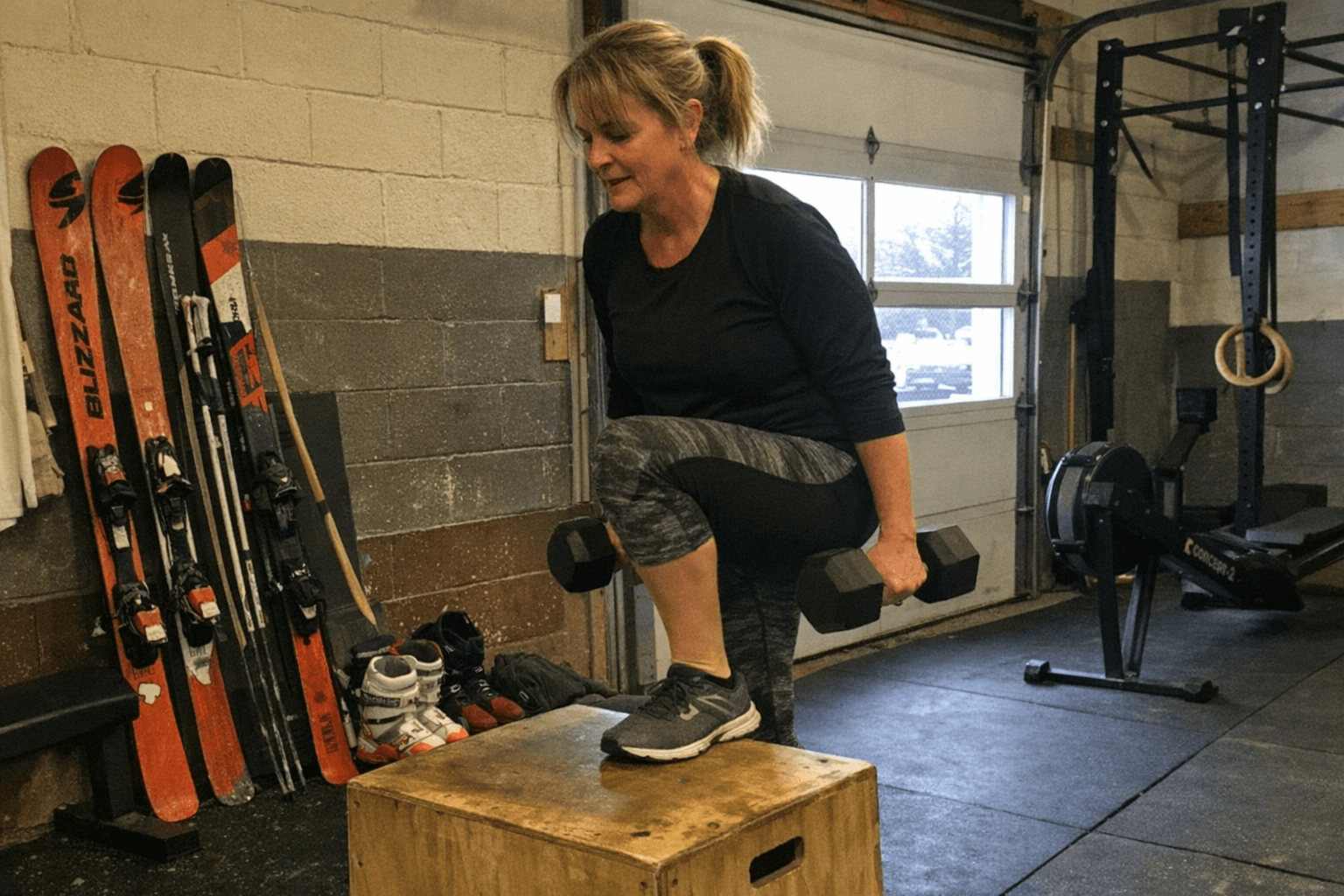
- step-ups
- deadlift variations
These build the strength to hold position, absorb force, and keep moving when the terrain gets messy or the session gets long.
2. Single-leg stability
Skiing is full of weight shifts, uneven pressure, and moments where one side has to do more than the other.
That is why single-leg work matters so much. It helps with balance, control, and cleaning up side-to-side weaknesses that can show up as knee irritation, hip wobble, or just feeling less solid on snow.
3. Core strength that actually transfers
Not six-pack stuff.
The useful kind.
You want a trunk that can resist twisting, hold position, and help transfer force between your upper and lower body. Carries, planks, loaded holds, rotational control, and bracing under load all matter here.
This is a big reason CrossFit-style training carries over so well. Good coaching does not just chase sweat. It builds the ability to stay organized while you move.
4. Posterior chain strength
Glutes, hamstrings, upper back. The stuff desk jobs tend to leave sleepy.
If you spend most of your day sitting, then ask your body to go ski hard on the weekend, you are asking a lot from tissues that have mostly been in park mode since Monday.
Strength training helps wake that system back up.
That is part of why outdoor athletes in Duluth often do well when they mix skiing or running with sports training. You do not need to stop doing the sport you love. You just need to support it better.
Strength helps you enjoy skiing longer, not just perform better
This part matters for CrossFit Aerial's crowd.
Most adults are not trying to podium at the Birkie.
They want to feel capable.
They want to go ski with friends or family and not be the person who fades early. They want to enjoy a long winter weekend. They want to trust their body more. They want fewer aches, better stamina, and more confidence doing the things that make Duluth feel like Duluth.
That is the real sell.
Strength training makes outdoor recreation more available.
It is the same reason we talk so much about training for hiking, biking, paddling, and just keeping up with regular life. Better strength does not only help inside the gym. It gives you more options outside of it too.
If that broader outdoor piece resonates, The Duluth Outdoor Guide is worth a read too.
The mistake a lot of adult skiers make
They wait until their body feels beat up to do something about it.
Usually the cycle goes like this:
- ski hard when the snow is good
- feel tight, sore, or unstable
- take a few days off
- repeat without building much actual capacity
That works for a while. Then winter starts feeling harder every year.
A better approach is to build strength before and during ski season so your body has more margin.
That does not mean crushing yourself in the gym five days a week.
For a lot of adults, two to four well-coached strength sessions a week is plenty. Especially if you are already skiing, walking, or staying generally active.
What if you have not worked out in years
Good. You are normal.
Seriously.
A lot of people hear strength training for skiers and picture someone who already knows how to lift, already has a routine, and already feels athletic.
That is not most people who walk into CrossFit Aerial.
A lot of our members are working parents, adults restarting fitness, and people who have spent years meaning to get back into shape. Plenty are outdoor people already. They just have not had a consistent strength routine in a long time.
That is why coaching matters.
If you are new, you do not need a ski-racer program. You need a place that can meet you where you are, scale things well, and help you build from zero without making it weird.
That is exactly the same reason our beginners do well here in general. If you want to see how the on-ramp actually feels, read What to Expect Your First Week at CrossFit.
This matters even more if you are 40, 50, or in our Legends crowd
A lot of Duluth adults want to keep skiing for a long time.
Not just this winter. For years.
That is a strength and durability conversation.
As we get older, muscle mass, balance, power, and recovery do not exactly improve on their own. If you want to stay capable on trails, hills, and icy parking lots, training helps.
That does not mean training like a maniac. It means being consistent.
That is why this conversation overlaps so much with our Legends program and longevity stuff. The goal is not to look intense online. The goal is to still be strong enough to do the life you want.
If that sounds like you, read CrossFit for Legends. It fits this conversation more than you might think.
Do skiers need nutrition support too?
Usually, yes.
If you are training in the gym and skiing regularly, under-eating catches up fast. A lot of adults do not realize how much better winter activity feels when they are eating enough protein, staying hydrated, and handling pre- and post-session fueling better.
That is especially true when the goal is to recover well enough to keep showing up.
If that part feels messy, sports nutrition coaching can help. You do not need to turn into a macro-counting robot. But you probably do need a better plan than coffee, vibes, and whatever snack is rolling around in the car.
You do not need a ski athlete identity to train like this
Maybe you ski a lot.
Maybe you just want to stop feeling cooked after a few runs or a long nordic session.
Maybe you are trying to get back to winter activities you used to enjoy more. Maybe you want your body to feel more trustworthy, period.
That counts.
You do not need to earn the right to strength train by already being fit. That idea keeps a lot of adults stuck.
The better way to think about it is simple: if skiing matters to you, getting stronger will probably help.
And if you want coaching, structure, and classes that actually meet normal adults where they are, that is exactly what we do at CrossFit Aerial.
You can learn more about the coaching and class side on our pricing page, and if you want a more sport-specific view, our sports training page lays that out too.
The bottom line
Strength training for skiers in Duluth does not need to be fancy.
It needs to be useful.
Build stronger legs. Better balance. A more durable trunk. More confidence under fatigue. Support the outdoor life you already want.
That is the win.
If you ski because winter feels better when you do, then strength training is one of the best ways to keep that part of your life going strong.
FAQ
Is strength training good for nordic skiers?
Yes. Nordic skiers benefit from stronger legs, better single-leg control, trunk stability, and better durability for longer sessions and uneven terrain.
Is strength training good for downhill skiers?
Yes. Downhill skiers usually benefit from stronger quads, glutes, trunk control, and better fatigue resistance so they can hold position and feel steadier through turns.
How often should skiers strength train?
For many adults, two to four sessions a week is enough to make a real difference, especially if they are already skiing or staying active in other ways.
Can I start strength training if I have not worked out in years?
Absolutely. Most adults need a scaled starting point, not a perfect one. Good coaching matters more than prior experience.
Does CrossFit help with skiing?
It often does when the programming and coaching are scaled well. Strength, conditioning, balance, and trunk control all carry over to skiing and other Duluth outdoor activities.