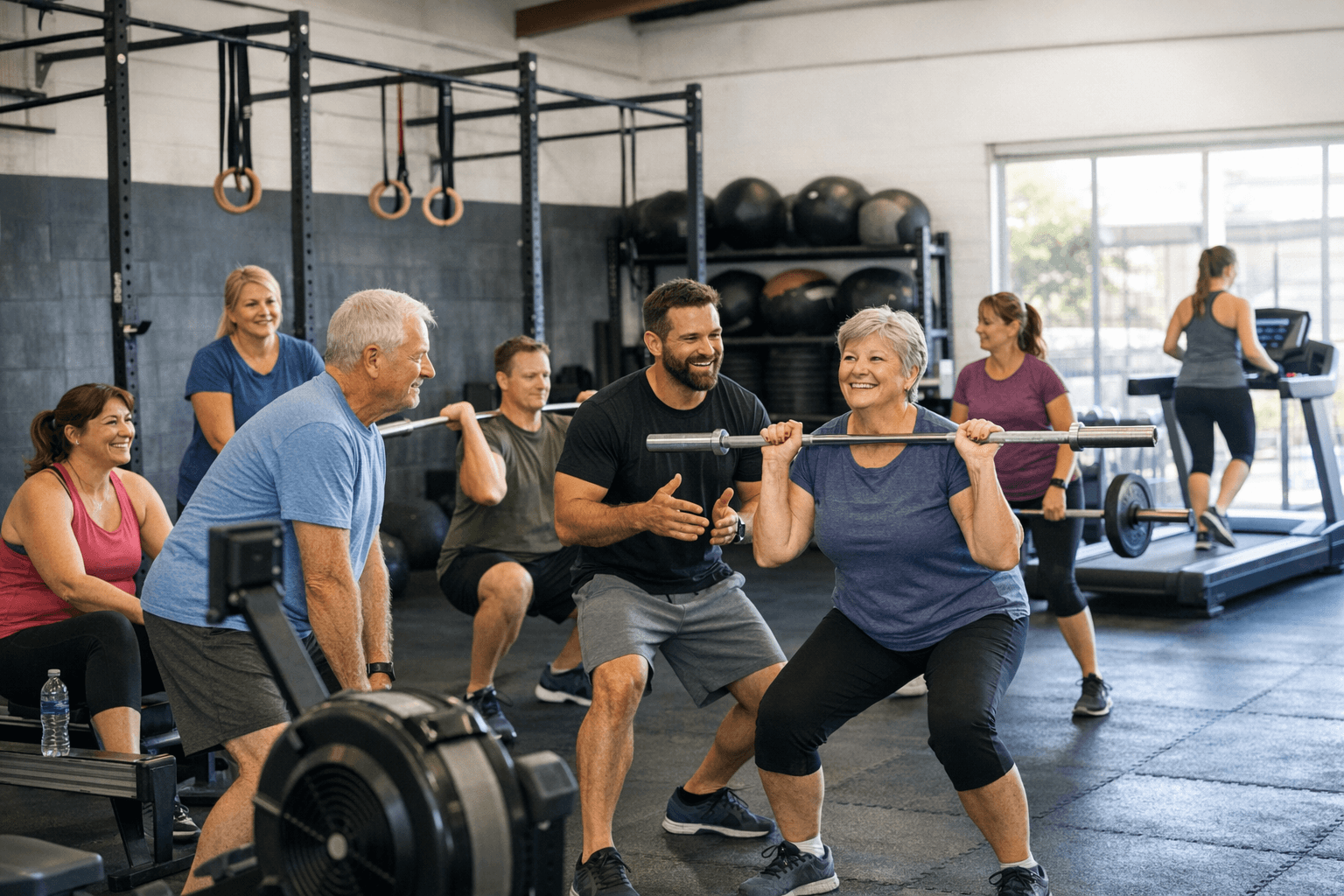
CrossFit vs Cardio for Fat Loss
Monday, Apr 13th, 2026If you are trying to lose fat, cardio is usually the first thing people think of.
You picture treadmills, long walks, spin bikes, maybe a sweaty orange-lit class where your watch tells you how many calories you burned. That makes sense. Cardio feels like "fat loss exercise" because it gets your heart rate up and it looks like work.
CrossFit can seem like a different category. Barbells. Rows. Kettlebells. Wall balls. Maybe a coach yelling time caps and a whiteboard full of stuff you do not understand yet.
So if your actual goal is fat loss, which one works better?
The honest answer is this: cardio can help, but for most adults trying to change their body and keep the weight off, CrossFit works better in real life.
Not because cardio is useless. It is not. Walking, biking, jogging, and aerobic work all matter.
But if you are a working parent, somebody getting back into fitness after years away, or just a normal adult in Duluth who wants to lose fat without living on a treadmill, CrossFit usually gives you more upside.
Cardio Burns Calories. CrossFit Changes More Than That.
This is where most people get tripped up.
Cardio is good at one very obvious thing. It burns calories while you are doing it.
That is not nothing. If you walk more, bike more, or mix in some conditioning, that absolutely helps with fat loss.
The problem is that calories burned during the workout are only one piece of the puzzle.
A lot of people spend months doing cardio, lose a little weight, then stall. They get lighter, but they do not feel stronger. Their body composition does not change as much as they hoped. Or they stop doing cardio for two weeks and everything backslides.
CrossFit attacks the problem from more angles.
It helps you:
- build muscle while losing fat
- keep your metabolism higher by holding onto lean mass
- improve conditioning and work capacity
- train movements that carry over to real life
- stay engaged because the workouts change and the coaching keeps you progressing
That is a big deal.
If you want the fuller breakdown, our page on CrossFit for Weight Loss gets into why body composition matters more than just scale weight.
Why Cardio Alone Often Stops Working
Cardio is easy to understand, which is part of why people default to it.
Walk more. Run more. Sweat more. Burn more.
The catch is that your body gets efficient.
That is actually one of the cool things about the human body, but it can be annoying if your entire fat-loss plan is based on burning as many calories as possible in a workout. Over time, the same run or bike session costs your body less. So to keep seeing the same payoff, you usually have to do more of it.
Longer sessions. More days. More boredom. More wear and tear.
That can work for some people, especially if they genuinely love endurance training.
But most adults we are talking to are not trying to become distance athletes. They want to feel better, look better, have more energy, and not get winded carrying a cooler to the lake or hiking a hill in Duluth.
That is where cardio-only plans often fall apart. They are repetitive, easy to skip, and do not do much to address strength, muscle, or the kind of capability people actually want.
Why CrossFit Usually Wins for Real-Life Fat Loss
CrossFit combines strength training and conditioning in the same system.
That matters because fat loss is not just about what happens during the workout. It is also about what your body becomes while you train consistently.
When you build strength and muscle, even gradually, you create a body that does more with the effort you put in. You look different. You move better. You usually handle food, stress, and recovery better than someone who is just trying to grind calories away.
CrossFit also tends to be more efficient for busy adults. Instead of deciding whether today should be lifting day, cardio day, or some random YouTube workout, you show up and the program is there. A coach helps you scale it. You do the work. You leave.
For people with jobs, kids, old injuries, or rusty fitness habits, that is huge.
A plan you actually follow beats a theoretically perfect plan you avoid.
That is part of why our pricing page matters in this conversation too. What you are paying for is not just access to equipment. It is coaching, scaling, accountability, programming, and community. That support is often what turns a good fat-loss idea into actual follow-through.
Fat Loss Is Easier When You Keep Muscle
This is the part a lot of people miss.
If you lose weight by dieting hard and doing a bunch of cardio, some of that weight is usually muscle.
That is not great.
Muscle helps with metabolism, posture, strength, injury resilience, and how your body actually looks. Most adults do not want to end up lighter but softer, weaker, and still tired.
They want to lose fat and keep the stuff that makes them feel athletic and capable.
CrossFit is better for that because resistance training is built in.
You squat. Press. Pull. Carry. Hinge. Jump. Row. Move your body through different ranges and time domains. That combination does a much better job of telling your body, “Keep the muscle, lose the extra fluff.”
That is one reason a lot of members notice progress before the scale says much. Clothes fit better. Energy improves. Posture changes. They feel more solid.
If you want a realistic version of that timeline, How Long Until You See CrossFit Results is worth reading.
Cardio Still Matters, Just Not as the Whole Plan
To be clear, this is not an anti-cardio rant.
Good cardio is useful.
Walking is great.
Zone 2 work is great.
Biking around Duluth is great.
Running can be great if your body tolerates it and you enjoy it.
A smart fitness plan usually includes some aerobic work.
CrossFit just tends to work better as the foundation for fat loss because it gives you strength and conditioning together. Then cardio becomes a tool, not your entire identity.
For example:
- walks on recovery days help with consistency and stress
- a little extra easy cardio can support fat loss without wrecking recovery
- outdoor activities in Duluth become more enjoyable when your strength improves too
That is a much healthier setup than trying to punish yourself thin with endless miles.
What Works Better for Beginners Who Have Not Worked Out in Years?
For true beginners, especially people who have been out of the game for a long time, CrossFit usually wins by a bigger margin.
Not because beginners need max intensity. They do not.
But because beginners need coaching.
They need someone to tell them how often to train, how hard to push, how to scale, and when to back off. They need a program that meets them where they are.
At CrossFit Aerial, that is the actual job. You are not expected to walk in already fit. A lot of members start from zero. A lot of them are parents. A lot are over 40. Some are in our Legends crowd and just want to keep moving well for a long time.
If that is you, read What to Expect Your First Week at CrossFit. It will give you a much more accurate picture than whatever highlight reel internet CrossFit put in your head.
The Problem Is Usually Not Knowledge. It Is Consistency.
Most adults already know the basic fat-loss formula.
Eat a little better. Move more. Do it for long enough.
That is not the hard part.
The hard part is staying consistent when work gets chaotic, the kids get sick, your motivation drops, or your routine gets disrupted.
Cardio-only plans are easy to skip because nobody notices. There is no class waiting for you. No coach expecting you. No one helping you adjust the day when your energy is low.
That is one of CrossFit’s sneaky advantages.
It is social. It is scheduled. It is coached.
That means it is often easier to keep doing after the first burst of motivation wears off. And long-term consistency is what actually drives fat loss.
If you are trying to figure out the right training rhythm, How Often Should You Work Out will help. For a lot of adults, three to four days a week of well-programmed training beats trying to do cardio every day until life punches a hole in the plan.
What About Nutrition?
This is where the annoying truth comes in.
Neither CrossFit nor cardio can fully outrun a messy diet.
If fat loss is the goal, nutrition still matters a lot.
Exercise helps you preserve muscle, improve insulin sensitivity, manage stress, and create momentum. But the food side still has to make sense.
That does not mean living on chicken breast and sadness. It means having a plan you can actually stick to.
We talked more about that in What to Eat Before and After CrossFit. And if you want the big-picture money question answered, Is CrossFit Worth It? covers why coaching plus accountability often beats cheaper options that never turn into results.
So Which One Should You Choose?
If you love cardio and it keeps you consistent, great. Keep some in the mix.
But if your actual goal is fat loss, and especially if you also want strength, confidence, better body composition, and a plan that fits real life, CrossFit is usually the better primary choice.
It is more complete.
It is more engaging.
It preserves muscle better.
It tends to produce more real-world strength.
And for a lot of adults, it is easier to stick with because you are not doing it alone.
That last part matters more than people think.
The Bottom Line
CrossFit vs cardio for fat loss is not really a battle between good and bad.
Cardio is useful.
CrossFit is useful.
But for most adults trying to lose fat in a sustainable way, CrossFit gives you more.
You get strength and conditioning.
You keep more muscle.
You build a body that looks better and works better.
You get coaching, scaling, and accountability.
And you are more likely to stay consistent long enough for the changes to actually stick.
If you have been stuck in the cycle of starting over with cardio every few months, this might be the sign to try a different foundation.
Not because cardio failed you.
Because you probably need a system, not just more sweat.
FAQ
Is CrossFit better than cardio for fat loss?
For most adults, yes. Cardio helps burn calories, but CrossFit usually works better for fat loss because it combines strength training and conditioning, helps preserve muscle, and is often easier to stick with long term.
Can I lose weight with cardio alone?
Yes, but many people hit a plateau with cardio-only plans because their body adapts and they lose some muscle along the way. It can work, but it is usually not the most effective long-term strategy for body composition.
Should I still do cardio if I do CrossFit?
Usually yes. Walking, easy aerobic work, biking, and outdoor activity can all complement CrossFit really well. The point is that cardio should support the plan, not be the whole plan.
Is CrossFit too intense for beginners who want fat loss?
Not when it is coached properly. Good CrossFit gyms scale workouts for beginners all the time. At CrossFit Aerial, plenty of members start after years away from exercise and ease in gradually.
How many days a week should I do CrossFit for fat loss?
For most beginners and busy adults, three to four days a week is a strong starting point. That is enough to build momentum while still leaving room for recovery, walking, and real life.