Pond Hockey Training in Duluth
Friday, Jul 3rd, 2026Pond Hockey Training in Duluth
If you play pond hockey in Duluth, you already know it is a little different from normal rink hockey.
The ice is rougher. The shifts can get longer. The footing is less predictable. It is colder, the wind can be weird, and nobody is giving you a clean bench-and-whistle rhythm.
That is part of why it is fun.
It is also why pond hockey can light up your hips, groin, low back, and lungs in a hurry if your body is not ready for it.
You do not need some elaborate off-ice program to fix that. Most adults do better with a simple mix of leg strength, side-to-side control, repeat sprint conditioning, and enough general fitness that the game still feels fun halfway through.
If you already read our pieces on strength training for hockey in Duluth, winter fitness in Duluth, or low-pressure winter activities in Duluth, this is the pond-hockey version of that same conversation.
Why pond hockey feels harder than people expect
Pond hockey looks casual right up until you are twenty minutes in and your legs are cooked.
A few things make it sneakier than indoor hockey:
- the ice is usually less consistent, which means more small balance corrections
- you spend more time starting and stopping without clean shift structure
- cold air and wind make everything feel a little more expensive
- you may be layering up, which changes how you move
- a lot of adults jump in without much recent training because pond hockey feels more pickup than sport
That last part matters.
A lot of working adults around here are not training like athletes all winter. They are working, parenting, shoveling snow, hauling kids to stuff, and trying to grab a game when they can. That is normal. It just means the game will expose what is undertrained.
The big weak links pond hockey tends to expose
Hips and groin strength
Pond hockey asks a lot from your adductors, glutes, and deep hip stabilizers.
You are pushing laterally, catching yourself on choppy ice, reaching in awkward angles, and repeating that when tired. If those areas are underbuilt, your groin gets cranky fast and your hips start feeling old before the game is over.
Repeat sprint power
Pond hockey has a lot of short bursts.
Chase a loose puck. Recover. Turn. Sprint again. Coast for a second. Then go again.
You do not need marathon conditioning. You need the kind of engine that lets your legs keep some pop after the first few hard efforts.
Balance and trunk control
Outdoor ice is not perfect.
That means your ankles, core, and upper body end up doing more stabilizing than people realize. If you are wobbly through the trunk or weak on one leg, pond hockey makes that obvious in a hurry.
What to train if you want pond hockey to feel better
You do not need a hockey-only circus workout. Simple stuff carries over well.
1. Single-leg strength
Step-ups, split squats, lunges, and single-leg RDLs all help.
Why? Because pond hockey is full of one-leg loading, awkward pushes, and trying to stay organized while moving fast on imperfect footing. Single-leg work helps you build control instead of just hoping both legs figure it out.
2. Lateral strength and groin work
This is one of the biggest pond hockey buckets.
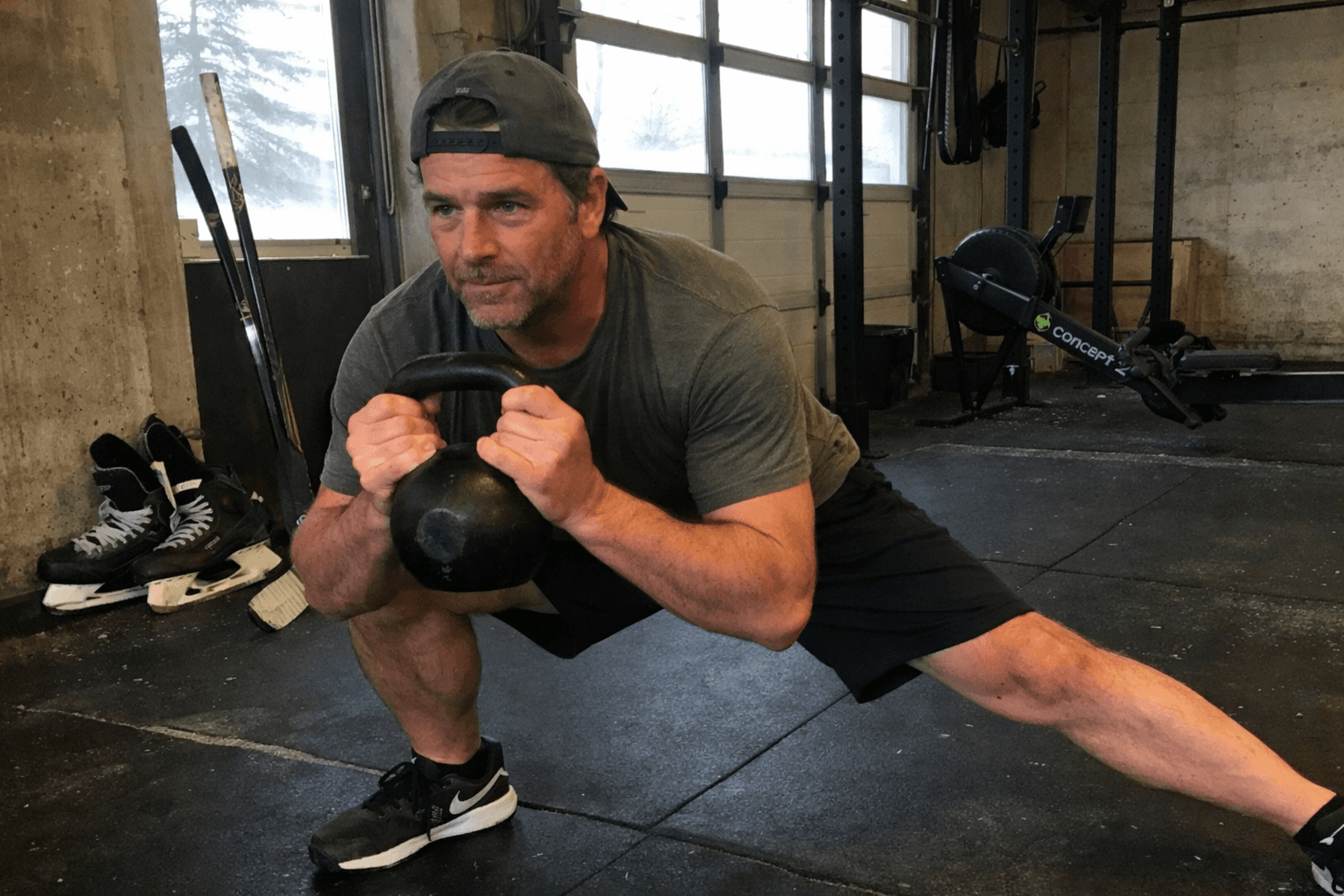
Lateral lunges, Cossack squats, skater hops, and Copenhagen plank progressions build the kind of side-to-side strength that keeps your hips and groin from feeling fragile all winter.
3. Posterior chain strength
Your glutes, hamstrings, and upper back matter more than most adults think.
Deadlift variations, hinges, rows, carries, and sled work help you keep a stronger skating position without asking your low back to do everything itself.
4. Short interval conditioning
Pond hockey is usually better matched by hard intervals than by long steady cardio.
Bike sprints, row intervals, sled pushes, and short work-rest pieces teach your body to recover just enough and go again. That is a lot closer to what a game feels like.
A simple weekly setup for regular adults
If you want to enjoy pond hockey more and feel less beat up after, a week like this is enough for a lot of people:
- 2 strength sessions with squats, hinges, split squats, rows, and carries
- 1 conditioning day built around intervals on a bike, rower, sled, or short circuit
- 1 to 2 pond hockey sessions, depending on weather and life
- some walking or light mobility so you are not going from desk to skates with nothing in between
That is realistic.
It also fits the way most adults in Duluth actually live. You do not need a perfect training block. You need enough structure to stop feeling ambushed by the game.
If you have not worked out in years, you are still allowed to start
This is where a lot of people hesitate.
They think they need to get into shape on their own first, then maybe start real training later.
That usually just turns into another winter of waiting.
At CrossFit Aerial, a lot of members start from zero. Working parents. Adults who have not trained in years. People who are plenty active outdoors but have not touched a structured strength program in a long time. The point is not to throw you into something reckless. The point is to meet you where you are and scale from there.
If that part still feels intimidating, What to Expect Your First Week at CrossFit walks through how the gym starts people off.
This matters for older adults too
A lot of adults want to keep skating, hiking, skiing, and doing winter stuff without feeling like each season shrinks their world a little more.
That is exactly why strength training matters.
It is not just about playing better. It is about keeping your balance, staying durable, holding onto muscle, and feeling more capable through Duluth winters. That is the same bigger idea behind our Legends article, even if your version of longevity is just wanting to skate outside for another ten winters.
Do not ignore recovery and fuel
If your legs always feel dead, your hips stay tight, or you fade fast in the cold, training may not be the only issue.
Sleep matters. Hydration matters. Eating enough protein matters. So does showing up to winter activity a little less under-fueled than most adults do.
If you want the broader consistency side of that, start with winter fitness in Duluth. If the bigger question is nutrition, our pricing page lays out the coaching options if you want more support than just classes.
The real goal
The goal is not to become a pond hockey performance lab project.
The goal is to enjoy the game more.
Better edges. Better hips. Less groin nonsense. Enough gas to keep moving late. More confidence saying yes when somebody texts about skating, instead of quietly thinking your body is going to hate you for it.
That is what strength training is for.
If you want help building that kind of durability, CrossFit Aerial works with regular adults, including plenty who are starting from scratch. You can learn more on the pricing page.
FAQ
What kind of training helps pond hockey most?
The best pond hockey training usually includes single-leg strength, lateral strength, groin work, posterior chain work, and short interval conditioning. Most adults do not need fancy drills. They need stronger hips, better balance, and enough engine to repeat hard efforts.
Why does pond hockey make my groin and hips so sore?
Pond hockey asks you to push laterally, stabilize on uneven ice, and keep doing it when tired. If your adductors, glutes, and trunk are undertrained, your hips and groin usually feel it first.
Is CrossFit good for hockey players in Duluth?
It can be, especially when the coaching is good and the workouts are scaled. A lot of adult hockey players do well with strength work, conditioning, and coaching that help them feel more durable without needing a sport-specific program every day.
What if I have not worked out in years but still want to play pond hockey?
You do not need to get in shape first. Plenty of adults start from zero. The key is starting with coaching and scaling instead of trying to guess your way back into shape alone.