Strength Training for Hockey in Duluth
Saturday, Jun 13th, 2026Strength Training for Hockey in Duluth
If you play hockey in Duluth, you do not need anyone to explain how fast your body gets exposed.
It might be a beer league game at night. It might be early youth practice before work. It might be a winter where you are on the ice a couple times a week and wondering why your hips, groin, low back, and knees all feel older than the rest of you.
That is where strength training helps.
Not because you need to train like a pro. You do not. Most adults here are just trying to skate harder, feel more stable, hold up through the season, and stop feeling wrecked after every game.
If you already liked our pieces on sports training in Duluth, sports nutrition in Duluth, or strength training for skiers in Duluth, this fits the same lane. Same city, same winter-body demands, just with more emphasis on hips, power, and staying durable when the season gets long.
What hockey season actually asks from your body
Hockey is short bursts, awkward positions, and a lot of force in not much time.
You accelerate, stop, turn, battle along the boards, recover for a minute, then do it again. Even if you are not chasing elite performance, the game still asks a lot from your legs, trunk, adductors, and lungs.
That usually shows up as a few common problems:
- hips and groins that feel tight all the time
- low backs that get lit up after skating in a bent-over position
- legs that lose pop late in the game
- knees that do not love all the cutting, stopping, and awkward transitions
- gas tanks that look fine in theory and disappear by the third period
That does not mean you are out of shape. It usually means hockey is exposing weak links that normal life lets you hide.
The three big weak links for most adult hockey players
1. Hip strength and adductor durability
A lot of hockey soreness starts around the hips and groin.
That makes sense. Skating asks you to produce force sideways, control deceleration, and keep repeating that pattern when you are tired. If your adductors, glutes, and trunk are underbuilt, the season starts to feel way more expensive on your body.
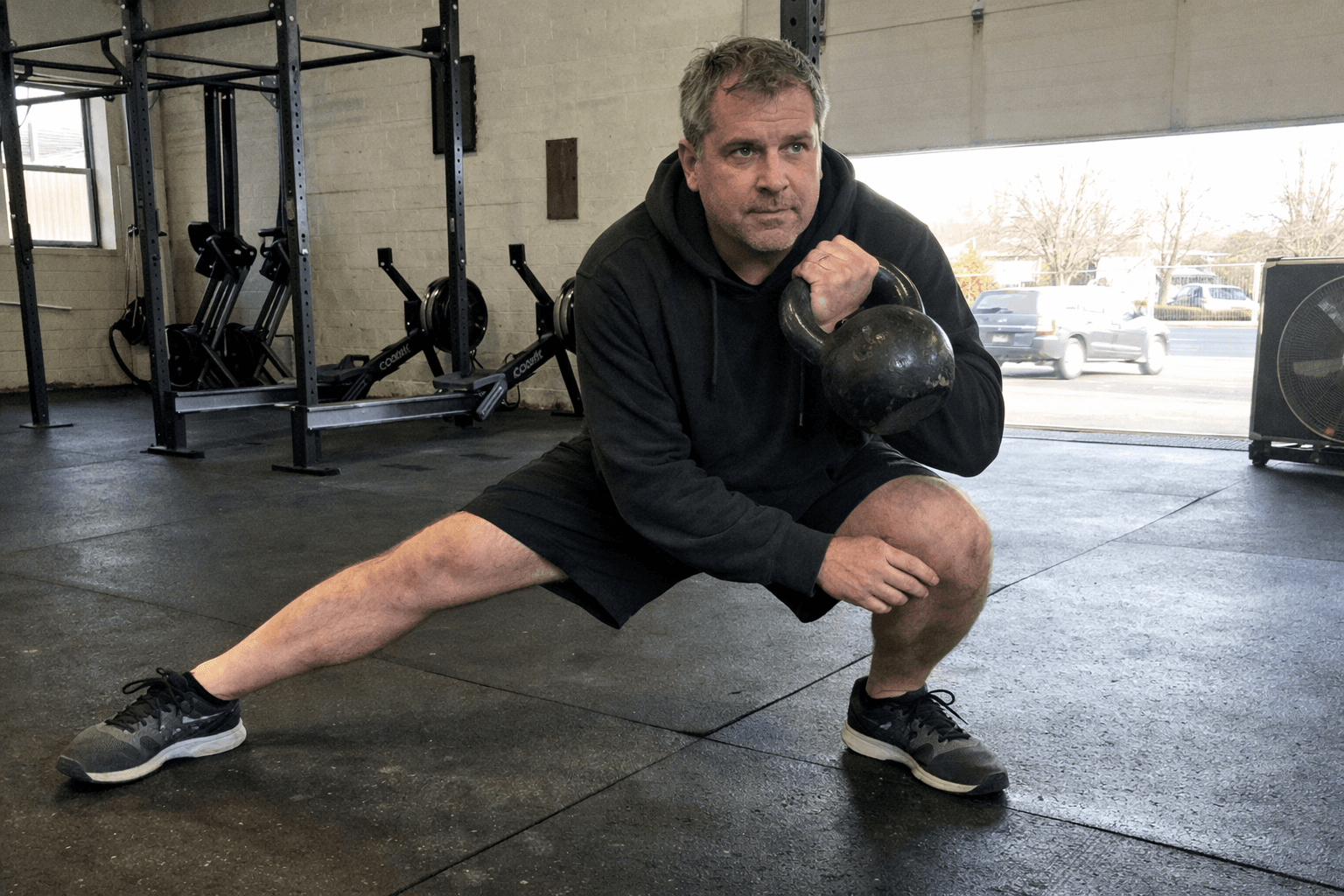
That is why split squats, lateral lunges, Cossack squats, Copenhagen plank progressions, and single-leg work matter so much. They build strength in the places hockey keeps stressing.
2. Power that lasts longer than one good shift
Most adults can skate hard for a little while.
The drop-off is the issue.
You feel springy early, then the legs get heavy, your stride shortens, and everything turns into survival skating. Strength training helps because it gives you more force per stride and better repeatability across the whole game.
Squats, deadlift variations, sled pushes, carries, bike intervals, and rowing all help here. You do not need fancy combine drills. You need stronger legs and a better engine.
3. Trunk and upper-body stability for contact and positioning
Even if you are not playing super high-level hockey, there is still plenty of bumping, reaching, bracing, and fighting for position.
If your trunk folds every time you get off balance, your low back and shoulders tend to pay for it. Carries, rows, presses, anti-rotation work, and basic upper-back strength matter because they help you stay more solid when the game gets messy.
What to train if you want to feel better on the ice
You do not need a weird hockey-only workout full of ladder drills and cones.
Most adults do better with simple, repeatable strength work that covers the big buckets.
Single-leg strength
Hockey is full of one-leg loading, side-to-side transitions, and uneven force.
That is why step-ups, split squats, lunges, and single-leg RDLs carry over so well. They help clean up imbalances and build the kind of control that shows up every shift.
Lateral strength and groin work
This is the part a lot of adults skip until something starts barking.
Lateral lunges, skater hops, adductor work, and controlled side-to-side strength make a big difference for people who want their hips and groins to stop feeling fragile all winter.
Posterior chain work
Glutes, hamstrings, and upper back do a ton for skating posture and repeat power.
Deadlifts, hinges, swings, sleds, and rows help you keep producing force without asking your low back to do all the work.
Conditioning that matches the sport
Hockey is not a long slow jog.
It is short hard efforts with incomplete recovery. That is why bikes, rowers, sleds, and interval pieces usually help more than mindless cardio. You are trying to build repeat sprint ability, not just collect sweat.
Why this matters even more for regular adults
Most adult hockey players in Duluth are not structuring life around training.
They are working, parenting, coaching youth teams, helping with rides, and squeezing their own games into the cracks. A lot of them have not followed a real strength plan in years. Some are basically trying to play the same way they played at 22 with a body that now sits at a desk all day.
That is a rough setup.
The good news is you do not need an elite schedule to feel a lot better. Two or three smart strength sessions per week can go a long way for rec league players, hockey parents who still skate, and adults who just want to enjoy the season without always nursing something.
If you are worried that you need to get fit before you start, you do not. Most people at CrossFit Aerial are starting from way closer to zero than they admit. What to Expect Your First Week at CrossFit walks through what that actually looks like.
If you are 40, 50, or older, durability matters more than ego
There are plenty of adults around here who still love the game, even if recovery is not what it used to be.
That is normal.
This is where strength training shines. It helps you keep muscle, keep your balance, protect your joints, and stay more capable for the stuff you want to keep doing. That is the same idea behind our Legends article, even if your version of longevity is just wanting your hips to survive another winter league season.
You do not need to win the warm-up. You need to still enjoy skating in ten years.
A simple week for an adult hockey player
If you want to feel stronger and less beat up during hockey season, a week like this is enough for a lot of people:
- 2 strength sessions built around squats, hinges, split squats, rows, and carries
- 1 conditioning day with bike, rower, sled, or intervals
- 1 to 3 skates, games, or practices depending on life and season
- extra walking and mobility so your baseline is not just chair to car to bench
That is realistic for working adults.
It is also way better than doing nothing until your groin gets cranky and then trying to foam-roll your way out of it.
Do not ignore the fuel side
A lot of hockey players focus on the game and ignore everything around it.
Then they wonder why late shifts feel terrible, recovery is slow, and body composition drifts the wrong direction all winter.
That is where sports nutrition in Duluth can help. Better fueling, hydration, and recovery habits make the strength work show up better on the ice.
The real goal
The goal is not to become a dryland-training psycho.
The goal is to make hockey season feel better.
More pop in your stride. Better hips. Less low-back nonsense. More confidence in contact. Fewer weeks where some small tweak steals the fun out of the game.
That is what good strength training is for.
If you want help building that kind of durability, check our pricing. CrossFit Aerial works with regular adults, including plenty who have not worked out in years, and we scale everything so you can build real strength without pretending you are already in hockey shape.