Strength Training for Ski Trips
Thursday, Jun 18th, 2026Strength Training for Ski Trips
A lot of adults in Duluth do not need help getting excited about winter.
They need help feeling ready for it.
The plan sounds great in October. Head to Spirit after work. Book a weekend at Lutsen. Meet friends for a snowboard day. Ski with the kids and still have enough left in the tank to enjoy dinner after.
Then the first real day on snow shows up and the usual stuff hits fast. Quads burning halfway down the hill. Knees feeling a little sketchy on chopped-up snow. Low back getting tight on the chairlift. A weird level of fatigue from doing something that was supposed to be fun.
That does not mean you are out of shape in some dramatic way. It usually means skiing and snowboarding ask for a very specific mix of leg strength, trunk control, balance, and repeat effort that most adults are not training by accident.
That is where strength work helps.
Not because you need to live in the gym all winter. You do not. But if you want ski trips and snowboard weekends to feel more fun and less like survival, a little training goes a long way.
Why ski trips humble people so fast
Downhill skiing and snowboarding are sneaky.
You are not just cruising. You are holding position, absorbing force, reacting to terrain, and repeating that over and over while your legs slowly fill with concrete.
A lot of adults hit one of these problems first:
- quads that are cooked way too early
- knees that feel unstable when fatigue sets in
- low back tightness from losing trunk position
- trouble controlling speed or turns once the legs are smoked
- soreness that lingers for days after one weekend
That is especially true if most of your week is spent sitting at a desk, driving kids around, or trying to squeeze workouts into whatever time is left.
If that sounds familiar, you are normal. It is the same reason a lot of local adults feel better on snow after they build some basic strength before winter. We see a similar carryover with hiking, snowshoeing, and other outdoor stuff too. The Duluth Outdoor Guide gets into that bigger picture.
The body parts that matter most
You do not need a fake “ski-specific” circus workout.
You need a body that can stay organized when the terrain gets messy and your legs get tired.
1. Quads that can keep working
This is the obvious one.
Downhill days are brutal on your quads because you are constantly braking, holding position, and absorbing force. If your legs are not used to that, every run starts feeling longer than it should.
Strength work helps by building more capacity with moves like:
- squats
- split squats
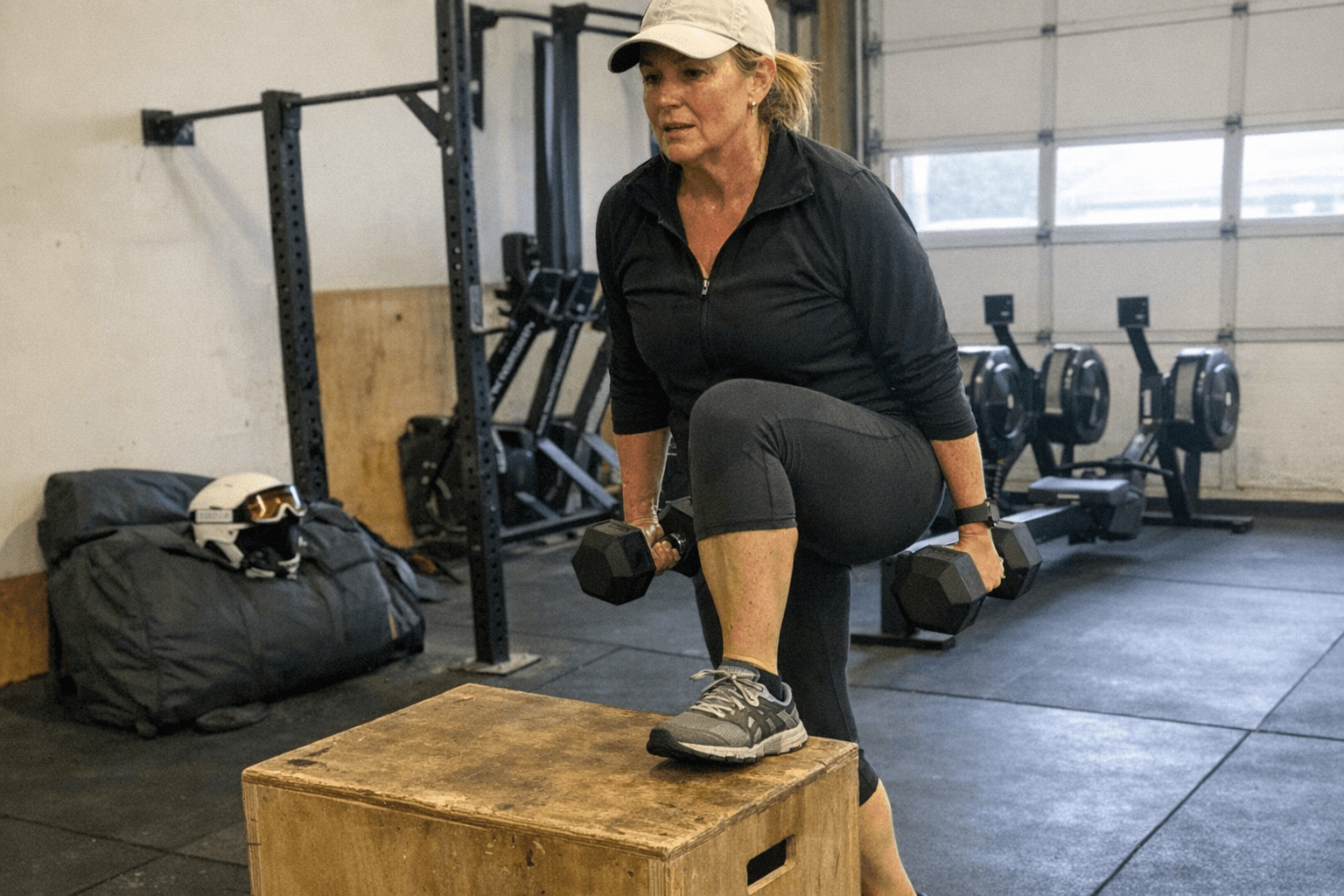
- step-ups
- lunges
- sled pushes
That kind of work does not just make you stronger. It helps your legs keep producing force when you are three runs in and the snow is getting choppy.
2. Knees that feel supported
Most people say “my knees hurt” when the bigger issue is that everything around the knee is underprepared.
Weak glutes, poor single-leg control, tired quads, stiff ankles, and sloppy trunk position all make the knee deal with more than it should.
That is why good training usually includes:
- single-leg strength work
- controlled step-downs
- lateral work
- ankle mobility and calf strength
- hip stability
The goal is not to baby the knee forever. It is to give the knee better help.
If knee pain already makes you nervous about classes or training, What to Expect Your First Week at CrossFit explains how the coaching and scaling side works here.
3. Trunk control so everything does not leak
When people say their low back gets tight skiing, it is often not just a back problem.
It is a position problem.
Once your trunk stops doing its job, your hips and legs lose some of their control. Then turns feel sloppier, your back starts taking extra stress, and your energy leaks fast.
This is why carries, planks, bracing drills, deadlift variations, and controlled rotation work matter so much. You need a torso that can stay solid while the rest of you moves.
4. Balance and side-to-side control
Snow is uneven. Conditions change fast. One leg always ends up doing a little more than the other.
Single-leg work helps clean that up before winter exposes it.
That matters for skiers, snowboarders, and honestly anybody who wants to feel less sketchy on ice and snow in general.
Skiing and snowboarding are different, but the training overlap is huge
Skiers and snowboarders do not move exactly the same way.
Snowboarders usually spend longer in one stance and need a lot of trunk control, leg endurance, and comfort absorbing bumps with both legs working together. Skiers deal with repeated turns, more obvious side-to-side force shifts, and a lot of quad fatigue.
But for regular adults, the overlap is still bigger than the difference.
Both groups benefit from:
- stronger legs
- better single-leg stability
- more trunk endurance
- better conditioning for repeated runs
- fewer weak links around the knees and hips
If you already loved our earlier piece on Strength Training for Skiers in Duluth, think of this as the downhill version. Less about long nordic sessions, more about strong legs, better control, and not getting wrecked by a weekend trip.
What a simple prep plan can look like
You do not need an elite offseason.
For most adults, two to four strength sessions a week is enough to make a real difference if the work is coached well and done consistently.
A useful plan usually includes:
- one or two lower-body strength days
- single-leg work every week
- trunk and carry work every week
- some conditioning so repeated runs do not destroy you
- enough recovery that you are not limping into the weekend
That is one reason group training works well for busy adults. You show up, the plan is already there, and somebody adjusts it to your level. You are not wandering around trying to invent a ski program between work and family stuff.
If you want more structure than a normal gym membership gives you, our pricing page breaks down what is actually included.
What if you have not trained in years
That is not a deal breaker. It is the norm.
A lot of people at CrossFit Aerial are working parents, adults restarting after a long gap, or people who are active outside but have not done much strength work in a while.
Nobody expects you to walk in already knowing what you are doing.
That is also true for older adults who still want to ski, snowboard with family, or just keep doing winter things without feeling fragile. Our Legends article gives a good picture of how training can still work really well later in life.
The real win
Most adults are not trying to become better skiers for the internet.
They just want winter to stay open.
They want to book the trip, say yes to the invite, ski with family, ride a full day, and wake up the next morning feeling tired in a satisfying way instead of wrecked.
That is what strength training is really buying you.
More good days outside. More confidence. Less wear and tear. More years where your body still feels like a teammate.
If that sounds like the goal, CrossFit Aerial can help. And if you are worried you need to “get in shape first,” you really do not. Around here, almost nobody starts that way.