Why Strength Training Helps Runners
Thursday, Apr 9th, 2026If you run enough, you eventually learn this the annoying way.
Running gets you better at running, up to a point. Then something starts barking. A knee. A hip. A calf. Your low back. Maybe nothing dramatic, just that steady feeling that your body is holding on with duct tape by the end of a longer run.
A lot of runners respond by doing more running, or by adding a little stretching and hoping that fixes it. Usually it doesn't.
Strength training helps runners because it gives you the stuff mileage alone does not. More durable legs. Better balance side to side. A stronger trunk so your form does not fall apart when you get tired. More pop on hills. Fewer little weak links getting exposed over and over again.
That matters whether you are training for Grandma's Marathon, getting ready for your first 5K, or just trying to enjoy a run on the Lakewalk without feeling beat up after.
At CrossFit Aerial, we see this pretty regularly. Plenty of people in Duluth love to run. They also hike, ski, bike, paddle, and chase kids around all week. Most of them are not trying to be full-time endurance athletes. They just want to feel strong enough that the things they enjoy don't keep wrecking them.
That is where strength work earns its keep.
Running is repetitive, even when you love it
There is a reason running builds fitness fast. It is simple. It is efficient. It adds up.
There is also a reason running tends to expose the same issues over and over. It is repetitive as hell.
You are doing thousands of steps in the same pattern. If one side is weaker, tighter, or less stable, you do not notice it once. You notice it after mile three, or mile eight, or week six of a training block.
That does not mean running is bad for you. It means your body needs more options than one movement pattern.
Strength training gives you those options.
Squats train both legs to produce force. Single-leg work helps clean up the side-to-side differences most runners carry around. Deadlifts and hinging teach you to use your hips instead of dumping everything into your knees and calves. Carries, presses, and pulls build the trunk strength that helps you hold posture when fatigue starts to show up.
If you are already running in Duluth, you have probably felt this on the hills. The issue usually is not cardio first. It is whether your legs and hips can keep doing their job once the terrain gets harder.
Strength training helps runners stay healthier
This is usually the first reason people start. They are tired of being almost healthy.
Not injured enough to fully stop, but not solid enough to train the way they want.
A lot of common running problems live in that zone:
- knees that get cranky when mileage climbs
- Achilles or calves that tighten up every week
- hips that feel uneven
- low backs that get smoked on long runs
- feet that seem fine until they suddenly don't
Strength work does not magically prevent every injury. But it does give your body more capacity.
That word matters. Capacity is what lets your tissues handle load without freaking out. If your glutes are stronger, your hips tend to control your stride better. If your hamstrings and calves are stronger, they can tolerate more force before they start complaining. If your trunk is stronger, you waste less energy wobbling around as you fatigue.
That is a big deal for adult runners, especially the ones balancing training with work, parenting, bad sleep, and the rest of normal life. You do not need a more complicated warmup ritual. Most of the time, you need a stronger body.
It can make you a better runner, not just a less fragile one
This is where some runners still get weird.
They hear "strength training" and picture bulking up, getting stiff, or wrecking their easy run legs. That is not how this works when it is programmed well.
Good strength training helps runners because it improves a few things at once.
You produce more force with less effort
Every stride asks you to absorb force and create force. The stronger you are, the less each stride takes out of you.
That can show up as better hill running, a stronger kick late in a race, or just less fading when you get tired.
You hold your form longer
Plenty of runners look smooth for the first few miles. Then fatigue hits and everything starts getting sloppy.
Your shoulders tense up. Your stride gets choppy. Your hips drop. Your feet start landing wherever they feel like.
Strength training helps you keep the shape of your run longer. That is useful whether you care about pace or just want the last part of the run to stop feeling miserable.
You get stronger in the planes running misses
Running is mostly straight ahead. Real life is not.
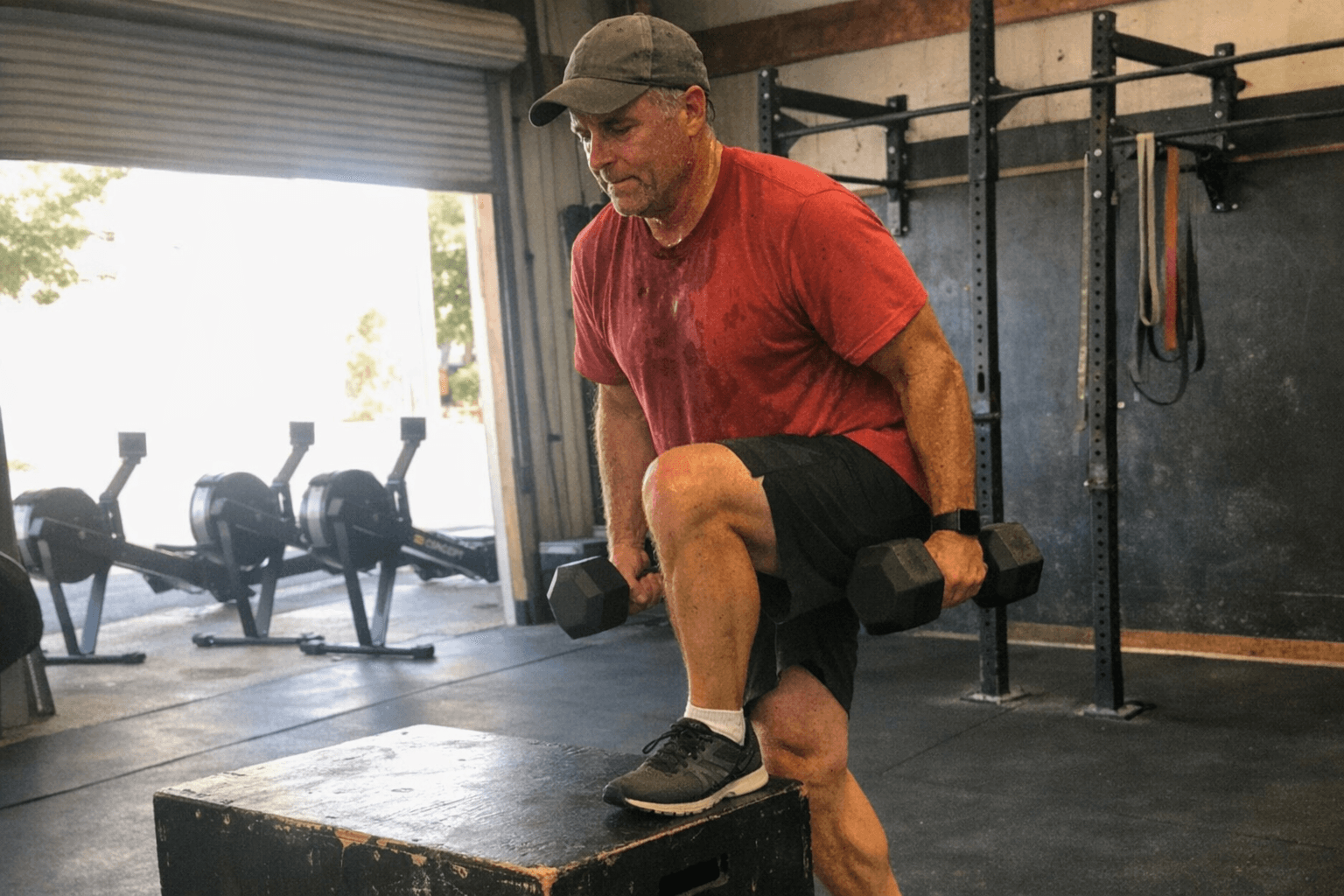
Single-leg squats, step-ups, lateral work, carries, and rotational control all build strength in ways that support running without just repeating running. That is one reason people often feel better on trails, uneven ground, and snowy sidewalks once they start lifting consistently.
What kind of strength training helps runners?
Not every gym approach is a great fit. Not every runner needs the same thing either.
But in general, the useful stuff looks pretty boring in the best way.
Things like:
- squats
- deadlifts and Romanian deadlifts
- step-ups
- lunges and split squats
- single-leg balance work
- carries
- pulling movements for upper back posture
- core work that involves resisting movement, not just doing crunches forever
The goal is not to turn every runner into a powerlifter. The goal is to build enough strength that your running feels better and your body handles training better.
At CrossFit Aerial, that usually means people get a mix of lower-body strength, trunk stability, and conditioning without having to build a whole second training life on their own. And because workouts are coached and scaled, runners are not guessing how hard to go when they are also trying to keep a long run on the calendar.
If you are already comparing approaches, Running in Duluth and How CrossFit Can Make You a Better Grandma's Marathon Runner are both worth reading too.
How often should runners strength train?
Usually less than your guilty conscience thinks.
For most adults, two strength sessions a week goes a long way. Three can work too, depending on your running volume, recovery, and what season you are in.
You do not need to lift heavy five days a week. You definitely do not need to be wrecked after every session.
If you are in a heavier running block, strength work should support your running, not compete with it. That means:
- keeping the volume reasonable
- avoiding junk fatigue
- not crushing your legs the day before an important run
- adjusting based on what your week actually looks like
This is one reason coaching matters. Good coaching keeps you from turning cross-training into another way to overcook yourself.
And if you are new to both lifting and running, starting smaller is usually smarter. Two strength sessions. A couple runs. Build from there. That is how people stay consistent.
Strength matters even more as you get older
This is not a young-runner-only conversation.
If you are in your forties, fifties, sixties, or beyond, strength work becomes even more useful. Not because you are fragile, but because muscle mass, power, recovery, and joint tolerance do not improve on their own.
A lot of adults can still handle the cardio side of running pretty well. What fades first is usually force production, tissue tolerance, and general sturdiness.
That is why strength training helps runners stay in the game longer. It helps you keep doing the thing you like without feeling like every season costs more than the last one.
If that angle hits home, CrossFit Over 40 and the Legends article both get into that broader picture.
You do not need to get in shape first
This comes up all the time. Especially with runners who have been doing their thing solo for years.
They know how to run, but they do not want to walk into a gym and feel behind. Or they know they should strength train, but the idea of learning lifts, movements, and class structure feels like a whole separate skill set.
Fair.
But this is exactly why coaching and scaling exist. Nobody needs to show up already knowing what they are doing. That is especially true at CrossFit Aerial, where a lot of people are starting from scratch in one way or another. Some have not worked out in years. Some are runners who have never lifted with intention. Some are parents trying to rebuild consistency after a long stretch of putting themselves last.
If that is you, read What to Expect Your First Week at CrossFit. The short version is simple: you do not need to earn your way into coached fitness.
What this looks like in real life
For most runners, strength work pays off in ordinary ways before it shows up in dramatic ones.
You feel steadier on hills. Your knees stop talking so much. You recover better after harder efforts. You do not feel like your posture caves at the end of every long run. Your easy pace starts feeling easier. You trust your body more.
That last one matters.
A lot of adults are not looking for elite performance. They want to train without constantly wondering what is going to flare up next. They want to run, hike, ski, bike, or sign up for the local event without feeling like their body is one bad week away from mutiny.
Strength work helps with that.
And in a place like Duluth, where so much of life is tied to being outside and moving well, that carries over into a lot more than race day.
The bottom line
Strength training helps runners because running is only part of the job.
Mileage builds fitness. Strength builds durability. Mileage builds specificity. Strength fills in the gaps. Mileage gets you ready to run. Strength helps your body handle the running you want to do.
You do not need to stop running. You do not need to become obsessed with lifting. You probably just need a smarter mix.
If you want that mix, CrossFit can be a really good fit, especially when it is scaled to your actual life and goals.
If you are curious what that could look like, check out our pricing page, What to Expect in Your First CrossFit Class, or How to Start CrossFit Even If You Haven't Worked Out in Years.
FAQ
Does strength training make runners slower?
No. Done well, it usually helps runners hold pace better, stay healthier, and produce more force with less effort.
How many days a week should runners lift weights?
For most adults, two days per week is enough to make a noticeable difference. Three can work if the rest of the week is managed well.
What strength exercises are best for runners?
Squats, deadlifts, step-ups, split squats, carries, pulling work, and single-leg strength exercises tend to be the big ones.
Should beginners strength train if they are just getting into running?
Yes. They just do not need much at first. A simple, coached plan beats trying to do everything at once.
Is CrossFit good for runners?
It can be. Especially if the workouts are coached, scaled, and treated as support for your running instead of a competition with it.
Running is repetitive, even when you love it?
There is a reason running builds fitness fast. It is simple. It is efficient. It adds up.
Strength training helps runners stay healthier?
This is usually the first reason people start. They are tired of being almost healthy.
It can make you a better runner, not just a less fragile one?
This is where some runners still get weird.
You produce more force with less effort?
Every stride asks you to absorb force and create force. The stronger you are, the less each stride takes out of you.
You hold your form longer?
Plenty of runners look smooth for the first few miles. Then fatigue hits and everything starts getting sloppy.
You get stronger in the planes running misses?
Running is mostly straight ahead. Real life is not.