Winter Walking Gear for Duluth
Thursday, Jul 23rd, 2026Winter Walking Gear for Duluth
If winter walking in Duluth keeps turning into a whole production, the problem is usually not motivation.
It is friction.
Your shoes are slippery. Your socks are wrong. Your coat is too bulky once you warm up, but not warm enough when you first step outside. Your hands freeze. You spend ten minutes debating whether the walk is worth it, then stay home.
That is the part a lot of adults run into. Working parents. Adults getting back into exercise after a long gap. Legends members. Outdoor people who like winter in theory but do not want every simple walk to feel like an expedition.
The good news is that winter walking gear does not need to get fancy.
A few smart upgrades usually make the difference between walking consistently and talking yourself out of it.
If you want route ideas once your gear is handled, pair this with Best Easy Winter Walks in Duluth, Best Windy-Day Walks in Duluth, or Best Indoor Walking Spots in Duluth.
The goal is not perfect gear. It is lower friction.
A lot of people overthink winter gear until it starts sounding expensive and annoying.
You do not need to dress like you are climbing a mountain just to get a 25-minute walk in.
You need gear that makes it easier to get out the door, stay reasonably warm, and avoid turning around because your feet are soaked or you are sliding around on every patch of ice.
For most Duluth winter walks, the basics are:
- shoes with decent traction
- warm socks that do not hold moisture
- layers you can adjust
- gloves that are easy to grab and easy to keep in a pocket or coat
- one or two small extras that remove excuses
That is enough for most people.
Start with shoes, because bad footing ruins everything
If your shoes do not feel stable, the walk stops being relaxing pretty fast.
That does not automatically mean you need a giant insulated boot.
A lot of winter walks go better with a regular walking or hiking shoe that has:
- solid tread
- enough room for thicker socks
- decent water resistance
- a stable feel on uneven or packed surfaces
For everyday city walking in Duluth, most adults do well with one of these setups:
Option 1: Trail runners or hikers with good tread
This is a great choice if you want something lighter and easier to walk in than a bulky boot.
Good for:
- plowed sidewalks
- packed paths
- neighborhood walks
- days when slush is limited
Option 2: Light winter boots
These make more sense if your routes are snowier, slushier, or you just run cold.
Good for:
- fresh snow
- wetter conditions
- slower casual walks
- adults who care more about warmth than pace
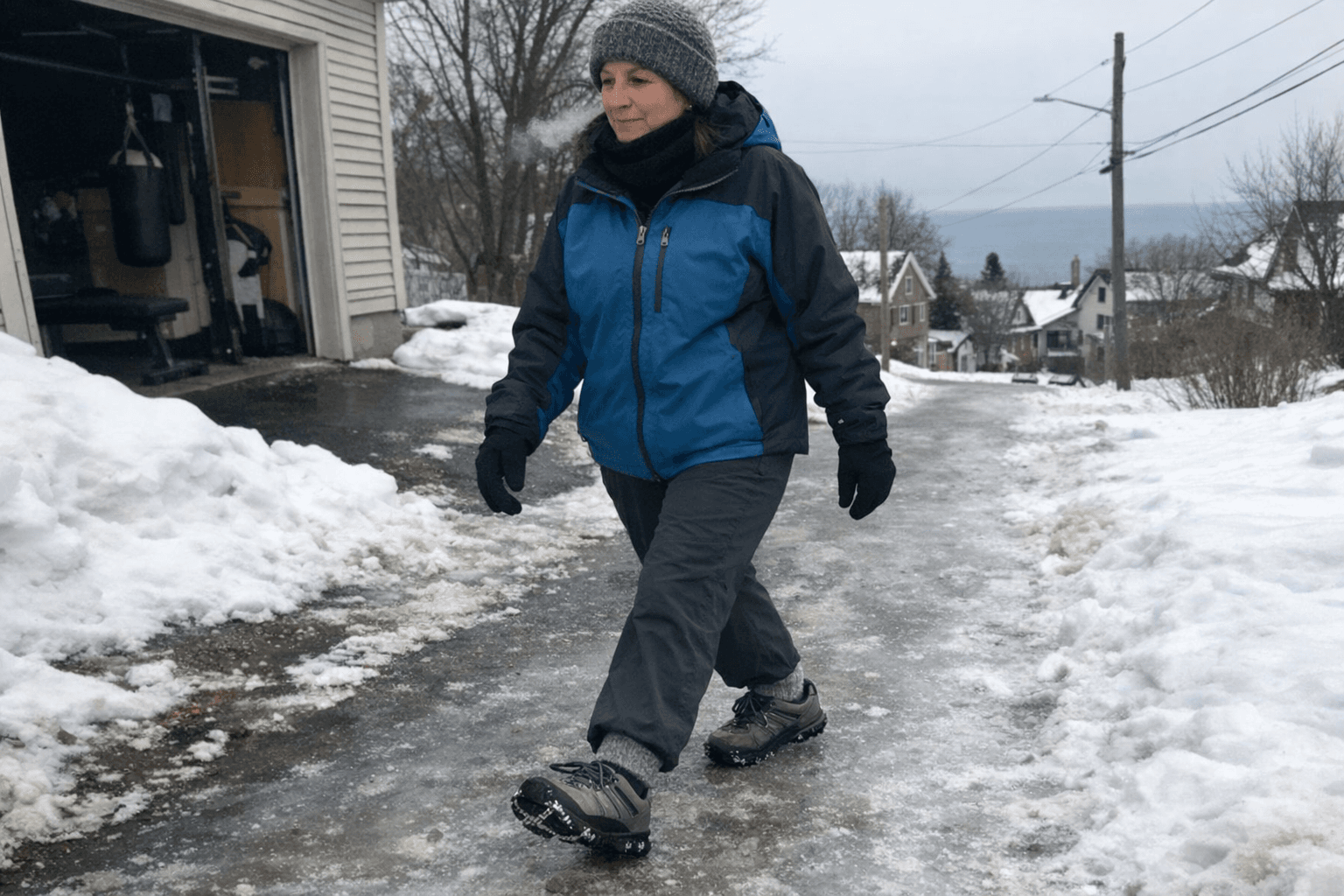
Option 3: Add traction cleats when it is truly icy
This is probably the biggest small upgrade for Duluth winter walking.
If sidewalks are glazed over or packed snow has turned slick, traction cleats matter more than debating between ten shoe models.
They are not glamorous. They work.
If icy footing is the main reason you skip walks, this is the upgrade to make first.
Socks matter more than people think
Cold feet can ruin the whole thing.
So can sweaty feet.
Cotton socks are usually a bad bet in winter because once they get damp, they stay uncomfortable.
A better move is a wool or wool-blend sock that keeps some warmth even when conditions are not perfect.
For most adults, you do not need the thickest sock in the store. You need one that:
- stays warm
- does not bunch up
- fits your shoe without making it too tight
- handles a little moisture better than cotton
If your shoes get tight with thicker socks, that is useful information. Cramped feet often get colder, not warmer.
Dress in layers, not one giant jacket
This is where a lot of winter walkers get it wrong.
They dress for standing outside, not for moving.
Then ten minutes into the walk they are sweaty, annoyed, and overheating.
A better setup is usually three simple layers:
1. A base layer that is not awful when you sweat a little
Think lightweight, breathable, and comfortable.
2. A middle layer for warmth
This could be a fleece, light insulated layer, or warm quarter-zip depending on conditions.
3. An outer layer that blocks wind or moisture
In Duluth, wind protection matters a lot. Sometimes more than extra bulk.
You do not need every layer every time. That is the point.
Layers let you adjust instead of committing to one bad guess.
If the weather itself is the bigger issue, Winter Warm-Ups in Duluth and Winter Recovery in Duluth both help on the body-feels-bad side of winter movement too.
Do not ignore hands, ears, and face
A lot of adults have shoes figured out and still hate walking in winter because the small exposed stuff makes them miserable.
Usually that means:
- hands getting cold fast
- ears hurting in the wind
- face feeling raw on colder days
A few easy fixes:
- keep one pair of gloves by the door and another in the car
- use a beanie or ear-covering headband you actually like wearing
- add a neck gaiter or buff on windy days
This is not about looking hardcore.
It is about removing the little annoyances that make you quit before the habit sticks.
Tiny upgrades that make winter walking way easier
These are the boring things that help more than people expect:
Keep a dedicated winter walking kit
Put gloves, hat, traction cleats, and an extra pair of socks in one spot.
If you have to hunt for everything every time, you will skip more walks.
Use a headlamp or reflective gear for darker hours
A lot of winter walking in Duluth happens before work, after work, or in that weird dim middle.
Visibility matters.
Bring a thermos to the car
Not for the walk itself necessarily. Just because the ritual helps.
If you know you are coming back to warm coffee or tea, going out often feels easier.
Have a default route
Gear helps. So does not having to decide where to go.
Pick one easy route for normal winter days and one backup plan for ugly ones.
That is why route guides like Best Winter Coffee Walks in Duluth and Winter Lunch-Break Walks in Duluth can be useful.
What to wear for different kinds of Duluth winter walks
You do not need the same setup every day.
For plowed neighborhood or sidewalk walks
Usually enough:
- trail shoes or light hikers
- wool socks
- base layer plus light outer layer
- gloves and a hat
For windier lakefront walks
Usually helpful:
- wind-blocking outer layer
- neck gaiter
- warmer gloves
- traction if surfaces are slick
For snowy or slushy walks
Usually helpful:
- water-resistant shoes or light boots
- wool socks
- pants that can handle moisture better than thin cotton joggers
- an extra dry pair of socks back in the car or house
Do not wait for perfect conditions to count a walk
This matters a lot for adults rebuilding consistency.
A shorter walk with decent gear still counts.
A 15-minute bundled-up walk still counts.
A parking-lot loop, neighborhood walk, or quick lunch-break reset still counts.
That is especially true if you have not worked out in years, if you are a parent fitting movement around real life, or if you just need some winter momentum back.
Around CrossFit Aerial, we see this all the time. People do better when movement feels repeatable, not heroic. Coaching helps with that inside the gym too. So does scaling. So does having a place where people know your name and help you keep moving even when life is messy.
If you are curious how that works, What to Expect Your First Week at CrossFit is the best place to start. And if you want the simple membership breakdown, our pricing page covers it. Most adults land somewhere in the $100 to $200 per month range depending on the level of coaching and support they want. What they are really paying for is coaching, scaling, programming, accountability, and a community that makes consistency easier.
A simple winter walking gear checklist
If you want the short version, start here:
- shoes with reliable tread
- traction cleats for icy days
- wool or wool-blend socks
- layers you can adjust instead of one giant coat
- gloves, hat, and something for wind on the face or neck
- one small gear kit that stays ready to go
That is enough to make winter walking feel way more doable.
The bottom line
The best winter walking gear for Duluth is usually not the most expensive setup.
It is the setup that makes it easiest to leave the house without a bunch of drama.
Better footing. Better socks. Better layers. A couple small upgrades that keep you warmer, drier, and less annoyed.
That is what helps the habit stick.
And for a lot of adults, that is the whole game.
FAQ
What shoes are best for winter walking in Duluth?
Usually trail shoes, light hikers, or light winter boots with solid tread. On icy days, traction cleats matter even more than the exact shoe.
Do I need winter boots for walking every day?
Not always. If sidewalks are plowed and slush is limited, many adults do fine in trail shoes or hikers. Boots help more when conditions are snowy, wet, or especially cold.
What socks are best for winter walking?
Wool or wool-blend socks are usually better than cotton because they stay warmer and handle moisture better.
What should I wear for a winter walk in windy weather?
Usually a breathable base layer, a warm middle layer, and an outer layer that blocks wind. Add gloves, a hat, and a neck gaiter if the wind is biting.
How do I make myself walk outside in winter more consistently?
Reduce friction. Keep your gear in one place, use traction on icy days, pick a default route, and count shorter walks as real wins.