Your 150-Person Tribe
Tuesday, Mar 24th, 2026Back in the 1990s, a British anthropologist named Robin Dunbar noticed something weird. He was studying primate brains and found a pattern: the bigger the primate's neocortex, the bigger their social group. Not surprising. But when he plugged in human brain size, the number that popped out was 150.
That's it. About 150 people. That's the maximum number of stable social relationships a human brain can maintain at any given time. Not acquaintances. Not people you recognize at the grocery store. Real relationships where you know who they are, how they connect to you, and roughly what's going on in their life.
Dunbar called it a "cognitive limit." Everyone else started calling it Dunbar's Number. And it explains a lot more about your gym than you'd think.
The Accidental Tribe
Here's what's interesting about CrossFit gyms. Most boxes cap out somewhere between 100 and 200 members. Not because of a business plan. Not because someone read Dunbar's research and said "let's stay under 150." It happens naturally.
The model doesn't scale like a big-box gym. You can't just add more treadmills. Classes have a coach-to-athlete ratio. There's only so much floor space. The programming is designed for groups small enough that a coach can actually watch your squat and tell you your knees are caving in.
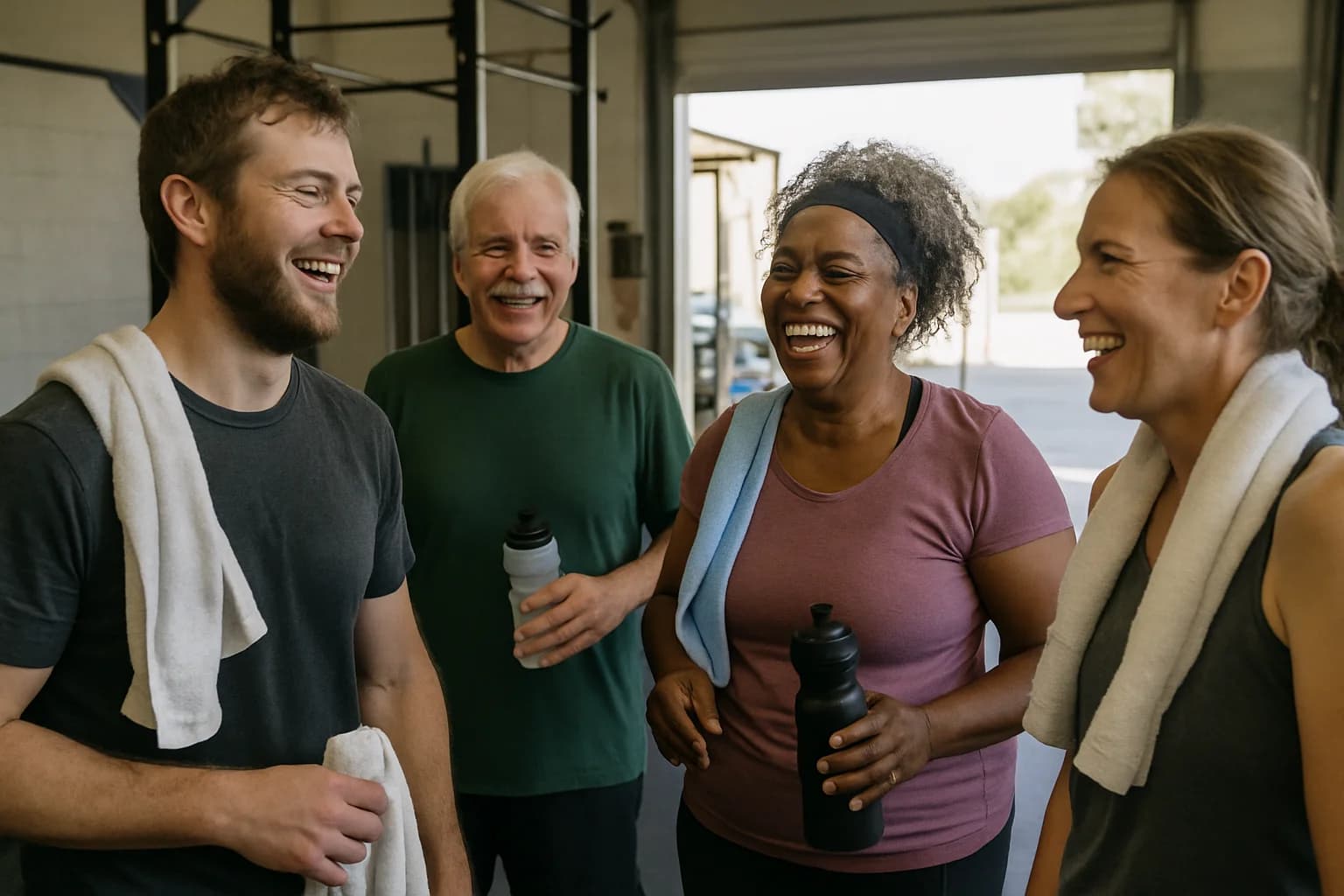
So you end up with this group of people — somewhere around 150 — who show up to the same place, do hard things together, and over time, start to actually know each other. Not "I've seen you on the elliptical" know each other. Like, "I know your kids' names and I noticed you weren't here last week" know each other.
That's not an accident. That's Dunbar's Number doing its thing.
Why 150 Matters More Than 15,000
A gym with 15,000 members sounds impressive on paper. In reality, it means you're anonymous. Nobody notices when you stop showing up. Nobody asks where you've been. The front desk person might scan your card and say "have a good workout," but that's about the extent of it.
Working out alone is a different experience entirely. It works great for some people. But for most of us — especially if we're trying to rebuild a fitness habit after years away — anonymity is the enemy.
One of our members, Lars, experienced this firsthand. He'd been consistent at CrossFit Aerial for a while, then took time off to train for a marathon. He worked out at home. Had the equipment, had the programming, had the discipline. But without the people around him, the motivation dried up. When he came back, he said he felt stronger and his mood was noticeably better. It wasn't the equipment he missed. It was the tribe.
Your Brain on Community
Dunbar's research goes deeper than just a number. Within that 150, there are layers:
5 people — your closest circle. The people you'd call at 2am.
15 people — good friends. You trust them, you make time for them.
50 people — your broader friend group. You'd invite them to a party.
150 people — your tribe. You know them well enough to have a real conversation if you bumped into them at a coffee shop.
In a CrossFit gym, those layers build organically. The people in your regular class time become your 15. The coaches, the Saturday crew, the people you see at community events become your 50. The full membership becomes your tribe.
And here's the part that matters for your health: research consistently shows that social connection is one of the strongest predictors of longevity. Stronger than exercise alone, stronger than diet alone. The Harvard Study of Adult Development — one of the longest-running studies on human happiness — found that the quality of your relationships at age 50 was a better predictor of physical health than cholesterol levels.
A gym that gives you 150 people who actually know you is doing more for your health than the workouts alone.
What This Looks Like at CrossFit Aerial
We're a small gym in Duluth. That's on purpose.
When you walk in for your first week, someone's going to introduce themselves. Not because we told them to, but because that's what happens in a group this size. Ricardo told us the thing that surprised him most was how welcoming everyone was. Mayson joined for the workouts and stayed for the community.
Those gym friendships don't stop at the door, either. Our members go hiking together, skiing together, biking together. Duluth is an outdoor city, and the people you meet at 6am tend to become the people you spend weekends with. That's not something a 15,000-member gym can replicate.
Our Legends program for members 55 and older is a perfect example. Arvid walked in at 82. He didn't come because he wanted to deadlift. He came because he wanted to be around people who were working on something together. The fitness was the vehicle. The community was the destination.
The Accountability Nobody Talks About
There's a practical side to Dunbar's Number in a gym setting, too.
When your gym is small enough that people know you, skipping becomes harder. Not in a guilt-trip way. In a "hey, we missed you yesterday" way. Someone texts you. A coach asks if everything's OK. Your workout partner gives you a hard time about it on Saturday.
That kind of accountability is worth more than any app notification or fitness tracker alert. It's human. It's real. And it only works when the group is small enough for people to notice.
This is part of why CrossFit is worth what it costs. You're not paying for access to equipment. You're paying for coaching, programming, and a community that's the right size to actually function like one.
Finding Your Tribe
If you're looking for a place to work out, you have plenty of options. Duluth alone has big-box gyms, boutique studios, running groups, and everything in between. But if what you're really looking for is a group of people who'll push you, support you, and actually remember your name — that's a smaller list.
Dunbar figured out that humans are wired for groups of about 150. CrossFit gyms happen to land right in that sweet spot. Not because anyone planned it. Because the model — small classes, shared suffering, real coaching — creates exactly the kind of environment where tribes form.
We've got room in ours. Come see what it's like.
The Accidental Tribe?
Here's what's interesting about CrossFit gyms. Most boxes cap out somewhere between 100 and 200 members. Not because of a business plan. Not because someone read Dunbar's research and said "let's stay under 150." It happens naturally.
Why 150 Matters More Than 15,000?
A gym with 15,000 members sounds impressive on paper. In reality, it means you're anonymous. Nobody notices when you stop showing up. Nobody asks where you've been. The front desk person might scan your card and say "have a good workout," but that's about the extent of it.
Your Brain on Community?
Dunbar's research goes deeper than just a number. Within that 150, there are layers:
What This Looks Like at CrossFit Aerial?
We're a small gym in Duluth. That's on purpose.
The Accountability Nobody Talks About?
There's a practical side to Dunbar's Number in a gym setting, too.
Finding Your Tribe?
If you're looking for a place to work out, you have plenty of options. Duluth alone has big-box gyms, boutique studios, running groups, and everything in between. But if what you're really looking for is a group of people who'll push you, support you, and actually remember your name — that's a smaller list.