CrossFit for Back Pain From Sitting
Friday, Apr 17th, 2026Short answer, yes, it often can.
But not because CrossFit is magic, and not because the answer to every cranky back is to go do a bunch of heavy deadlifts tomorrow.
If your back hurts because you sit most of the day, feel stiff through your hips, have a hard time standing tall, and generally feel like your body has slowly turned into an office chair, then smart strength training can help a lot. CrossFit can be part of that if the coaching is good, the movements are scaled, and the goal is to rebuild strength instead of trying to prove something.
That matters because most adults dealing with this are not twenty-three-year-old fitness junkies. They are working parents, desk workers, and adults who have not trained consistently in years. Around CrossFit Aerial, that is normal. Nobody walks in moving perfectly. Nobody has to.
One important note up front. This article is about common, non-emergency back pain that tends to show up with long periods of sitting and deconditioning. If you have numbness, weakness, pain shooting down your leg, sudden severe pain, or symptoms that are getting worse fast, talk to a medical professional first.
Why Sitting Makes Your Back Feel So Bad
Sitting itself is not evil. Sitting for ten hours a day and doing almost nothing to balance it out is the problem.
Over time, a few things usually happen:
- your hips get tight
- your glutes stop doing much
- your upper back gets stiff
- your core gets weaker at the exact job it is supposed to do, which is stabilizing you while you move
- your lower back starts picking up work it should not have to do
That is why a lot of people say the same stuff when they first come in:
"My back is always tight when I get out of the car."
"I feel fine once I move around, but sitting wrecks me."
"I know I should work out, but I feel too beat up to start."
That cycle is common. It is also one reason people end up reading pieces like How CrossFit Fixes Your Desk Job Body. The short version is that your body usually does better with smart movement and strength than with more inactivity.
So Can CrossFit Actually Help?
For a lot of people, yes.
CrossFit helps when it gives your body back the things sitting has been taking away:
- stronger glutes and hamstrings
- better hip range of motion
- better upper-back strength
- more confidence bending, carrying, squatting, and getting up off the floor
- regular movement instead of random all-or-nothing attempts to "get back into shape"
That does not mean every CrossFit workout is automatically perfect for every sore back.
It means a good coach can use CrossFit principles to help you move better, get stronger, and gradually tolerate more without flaring things up.
That distinction matters a lot.
What Helps Most for Back Pain From Sitting
Usually it is not some fancy rehab trick.
Usually it is a steady dose of basic things done well.
1. Learning to Hinge Again
A lot of adults with desk-job back pain are scared to bend over. That makes sense if bending has felt sketchy for a while.
But avoiding the hinge completely usually does not fix anything. You still have to pick up laundry baskets, groceries, dog food, backpacks, and all the other normal-life stuff.
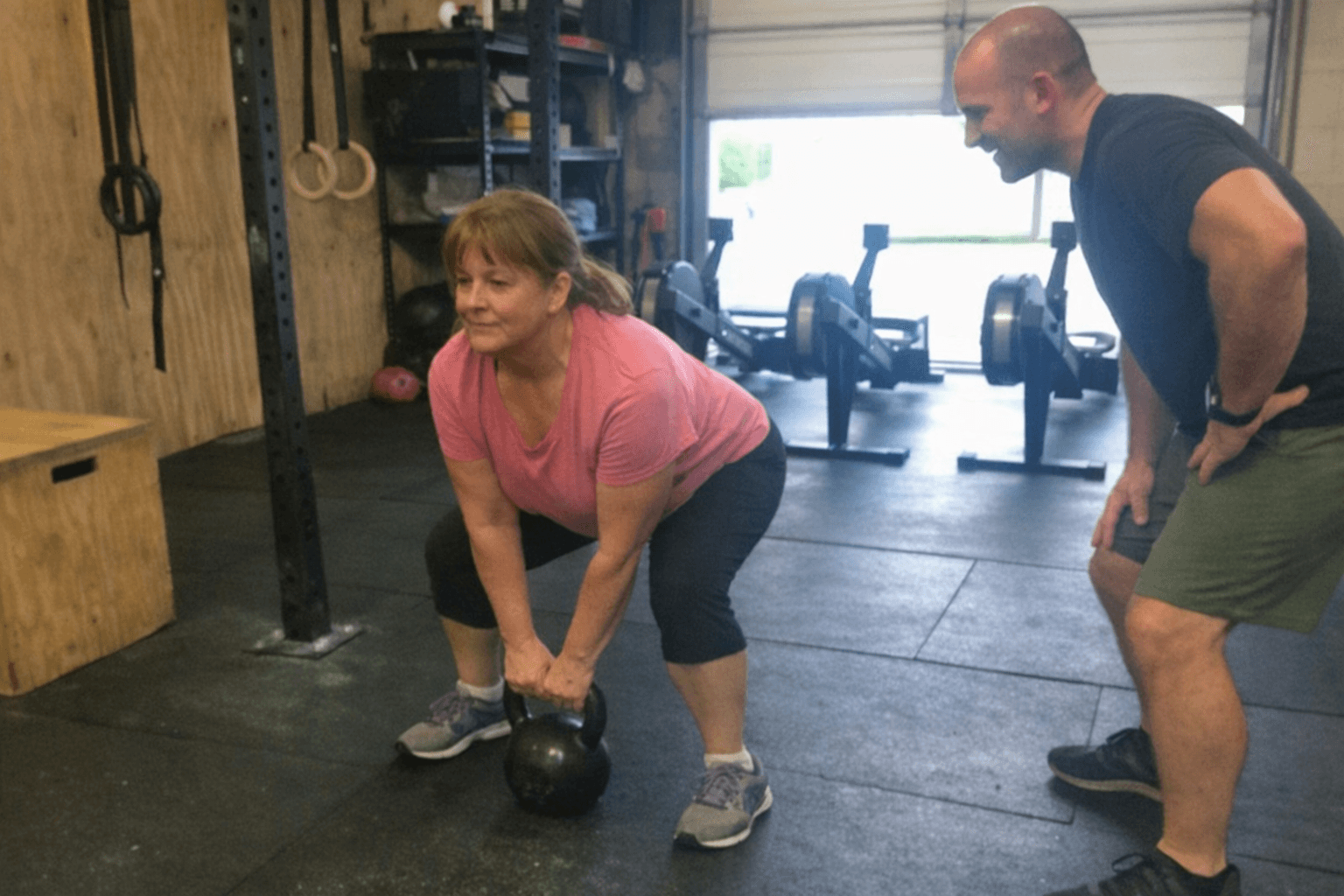
Good training teaches you how to hinge with your hips, brace your trunk, and use your legs and glutes instead of dumping everything into your low back. That might start with a PVC pipe, a kettlebell from blocks, or a very light deadlift pattern. It does not have to start heavy.
2. Building Glutes and Hamstrings
This is the unsexy answer, but it works.
When your backside is weak, your lower back often ends up doing too much. Squats, deadlift variations, sled work, carries, step-ups, and even simple bodyweight drills can help rebuild that support.
At CrossFit Aerial, this is one reason scaled strength work matters so much. The point is not to copy the fittest person in the room. The point is to train the muscles your desk job has been underusing.
3. Getting Your Upper Back Moving Again
Low back pain is not always just a low back problem.
If your thoracic spine is stiff and your shoulders live in a rounded-forward keyboard position all day, your body tends to find movement somewhere else. A lot of times that "somewhere else" is your low back.
Rows, carries, presses, hanging progressions, and smart mobility work can help you spread the load better through your whole body.
4. Practicing Core Stability Instead of Just Ab Exercises
Most adults do not need more random crunches.
They need to get better at bracing, breathing, carrying load, and staying stable while the rest of the body moves. Farmer carries, front rack holds, dead bugs, planks used well, and controlled strength work do a lot more here than chasing a six-pack.
5. Moving Consistently
This one is huge.
The body usually likes regular, manageable movement more than weekend-warrior heroics. A lot of back pain from sitting gets worse when the pattern is five days of stillness followed by one overly ambitious workout.
Three smart sessions a week usually beats one chaotic hard session every time.
What CrossFit Should Look Like If Your Back Already Hurts
If you have back pain now, the right starting point is not "just push through it."
It should look more like this:
- a coach asking questions before class starts
- movement screening or at least a real conversation about what hurts and what does not
- lighter loading at first
- shorter ranges of motion if needed
- substitutions when a movement is clearly a bad fit that day
- gradual progress, not ego lifting
This is exactly why the onboarding process matters. If you are wondering how the first part of that works, What to Expect Your First Week at CrossFit lays it out. Around here, we do not just throw brand-new people into the deep end and hope for the best.
What Usually Makes It Worse
A few things tend to backfire fast.
Going Too Heavy Too Soon
If you have not trained in years, your tissues are probably not ready for max-effort anything.
The answer is not babying yourself forever. It is respecting the ramp-up.
Treating Soreness and Pain Like the Same Thing
Some muscle soreness is normal when you start training. Sharp pain, weird nerve symptoms, or pain that keeps escalating is different.
If you are not sure where that line is, How Sore Should You Be After CrossFit helps clear it up.
Doing Random Internet Rehab While Ignoring Strength
Mobility drills can help. Walking can help. Standing desks can help a little.
But if you never rebuild strength, you are usually just managing symptoms around the edges.
Joining a Gym Where Nobody Coaches
A lot of people with back pain do badly at big-box gyms for one simple reason. Nobody is watching. Nobody adjusts anything. Nobody knows what your body is dealing with.
That is a big part of the value in coached training. What Does a CrossFit Coach Do gets into that more, but the short version is that good coaching keeps you from guessing.
What About Older Adults or People Who Feel Really Deconditioned?
They may benefit the most.
The people who assume CrossFit is off-limits are often the exact people who need smart functional strength training the most. If you are over 55, have not worked out in years, or just feel stiff and cautious all the time, you are not some weird exception. You are a very normal starting point.
That is part of why the Legends article matters. It is a good reminder that getting stronger later in life is still on the table, even with a history of surgeries, stiffness, or a lot of time away from exercise.
What Results Should You Actually Expect?
Usually the first wins are not dramatic.
They are things like:
- getting out of the car without that stuck feeling
- not feeling wrecked after a long workday
- being able to sit, stand, and walk with less stiffness
- carrying groceries without thinking about your back
- sleeping better because your body is not as cranky
- feeling more confident doing normal life stuff
That is real progress.
And for a lot of busy adults, those wins matter more than some huge before-and-after picture.
Is CrossFit Better Than Stretching for Desk Job Back Pain?
Usually, yes, though they are not really competing.
Stretching can make you feel better for a bit. Strength training changes the capacity of the system.
If your hips are tight because you sit all day, stretching them might give short-term relief. If your hips are tight and your glutes are weak and your trunk is undertrained, then getting stronger is often the bigger long-term move.
That is where a well-run CrossFit gym can shine. You are not just chasing relief. You are building a body that handles life better.
What If You Are Nervous to Start Because Your Back Already Bugs You?
That is reasonable.
A lot of adults feel like they need to get their pain totally solved before they begin training. In practice, it often works the other way around. Training, done intelligently, is part of how things improve.
You do not need to show up fit. You do not need to show up pain-free. You do need to show up honest.
Tell the coach what is going on. Tell them what movements usually bother you. Tell them how long it has been since you trained. That gives them something to work with.
And if the idea of class still feels intimidating, remember that CrossFit Aerial works with plenty of people who start from zero. Working parents. Desk workers. Legends members. People who want to feel better in their body again and get back to enjoying Duluth outside the gym too.
The Pricing Question People Usually Mean
A lot of people quietly ask a version of this:
"Is it worth paying more for coached training if my main goal is just to stop feeling terrible?"
For a lot of adults, yes.
If a cheap gym membership sits unused because you do not know what to do, that is not actually cheaper. What you are paying for with CrossFit is coaching, programming, scaling, accountability, and a plan that can adjust to real life. That is the stuff that helps people keep going.
If you want the straightforward numbers and the bigger value breakdown, the pricing page is the place to look.
The Bottom Line
Can CrossFit help back pain from sitting all day?
It often can, if the issue is the very common mix of stiffness, weakness, deconditioning, and too much time in a chair.
The key is not intensity for the sake of intensity. It is smart coaching. It is scaling. It is rebuilding strength where your body has lost it. It is moving consistently enough that your back is not the weak link in normal life anymore.
If that sounds like what you need, the best first step is not trying to diagnose yourself into paralysis. It is starting a conversation and letting a coach help you find a version that fits.
Meta description: Can CrossFit help back pain from sitting all day? For many adults in Duluth, smart scaled strength training helps more than more stretching alone. Here is what actually works.
Featured image prompt: Candid iPhone photo of a middle-aged woman doing a light kettlebell deadlift with a coach nearby in a small CrossFit box. Pull-up rig and rowers softly visible in the background, natural light from garage doors, slightly imperfect framing, real person not a model, mild effort visible, welcoming garage gym feel, no barbells, no dramatic pose.
Why Sitting Makes Your Back Feel So Bad?
Sitting itself is not evil. Sitting for ten hours a day and doing almost nothing to balance it out is the problem.
So Can CrossFit Actually Help?
For a lot of people, yes.
What Helps Most for Back Pain From Sitting?
Usually it is not some fancy rehab trick.
1. Learning to Hinge Again?
A lot of adults with desk-job back pain are scared to bend over. That makes sense if bending has felt sketchy for a while.
What about 2. Building Glutes and Hamstrings?
This is the unsexy answer, but it works.
3. Getting Your Upper Back Moving Again?
Low back pain is not always just a low back problem.