CrossFit for Knee Pain
Sunday, May 3rd, 2026If your knee has been cranky every time you squat, go down stairs, kneel to tie a shoe, or get up off the floor, it is pretty normal to wonder if CrossFit is the worst possible thing for it.
A lot of people hear “CrossFit” and picture endless jumping, deep squats, running, and people grinding through pain because they do not want to look weak.
That version gets a lot of attention online. It is not what good coaching looks like in real life.
At CrossFit Aerial, knee pain does not automatically mean you need to stop training. Usually it means you need to train smarter for a while.
For most adults, especially the ones coming in after years away from exercise, years at a desk, old sports mileage, or just a long stretch of life happening faster than recovery, the goal is not to prove toughness. The goal is to keep building strength, confidence, and day-to-day capacity without feeding the problem.
If you are brand new, start with What to Expect Your First Week at CrossFit. It gives a much more accurate picture of how beginners are coached than whatever highlight reel the internet handed you.
First, knee pain is common, but it is not all the same
“Knee pain” covers a lot of ground.
For some people it shows up at the front of the knee when they squat. For some it feels more like stiffness after sitting. For some it only shows up with impact, running, box jumps, or hiking downhill. For others it is an old injury that never fully stopped being annoying.
A few common reasons knees get cranky:
- jumping into too much volume too fast
- weak glutes and hamstrings so the knee keeps doing more than it should
- poor squat mechanics or range that you do not control well yet
- low tolerance for impact after years away from training
- stiffness through the ankles or hips that gets dumped into the knee
- trying to “push through” movements your body is clearly not tolerating well
That does not mean every knee issue is simple, and it does not mean a gym should pretend to diagnose your knee over the internet. If you have major swelling, locking, buckling, a fresh injury, sharp pain that is getting worse, or symptoms that are not settling down, talk to a medical professional.
But for a lot of adults, the answer is not to stop moving forever. It is to get coached, modify the right things, and rebuild strength around the problem.
The worst options are usually all or nothing
Most people make one of two mistakes.
Mistake one: stop everything
They stop squatting, stop training, stop showing up, and lose momentum. Then they come back weaker, stiffer, and more cautious than before.
Mistake two: ignore the message
They keep doing the same jumps, the same depth, the same loading, and the same pace, hoping the knee magically gets the hint.
That usually does not go great either.
The better path is almost always somewhere in the middle. Keep training what you can train, modify what your knee is not tolerating well, and gradually build back toward more capacity.
That is one reason coached training works so much better than trying to guess your way through it alone.
Good coaching gives you options, not pressure
A good class does not act like scaling is failure.
If your knee does not love high-volume air squats today, that does not mean your workout is ruined. It means the coach gives you a better version for today.
That might look like:
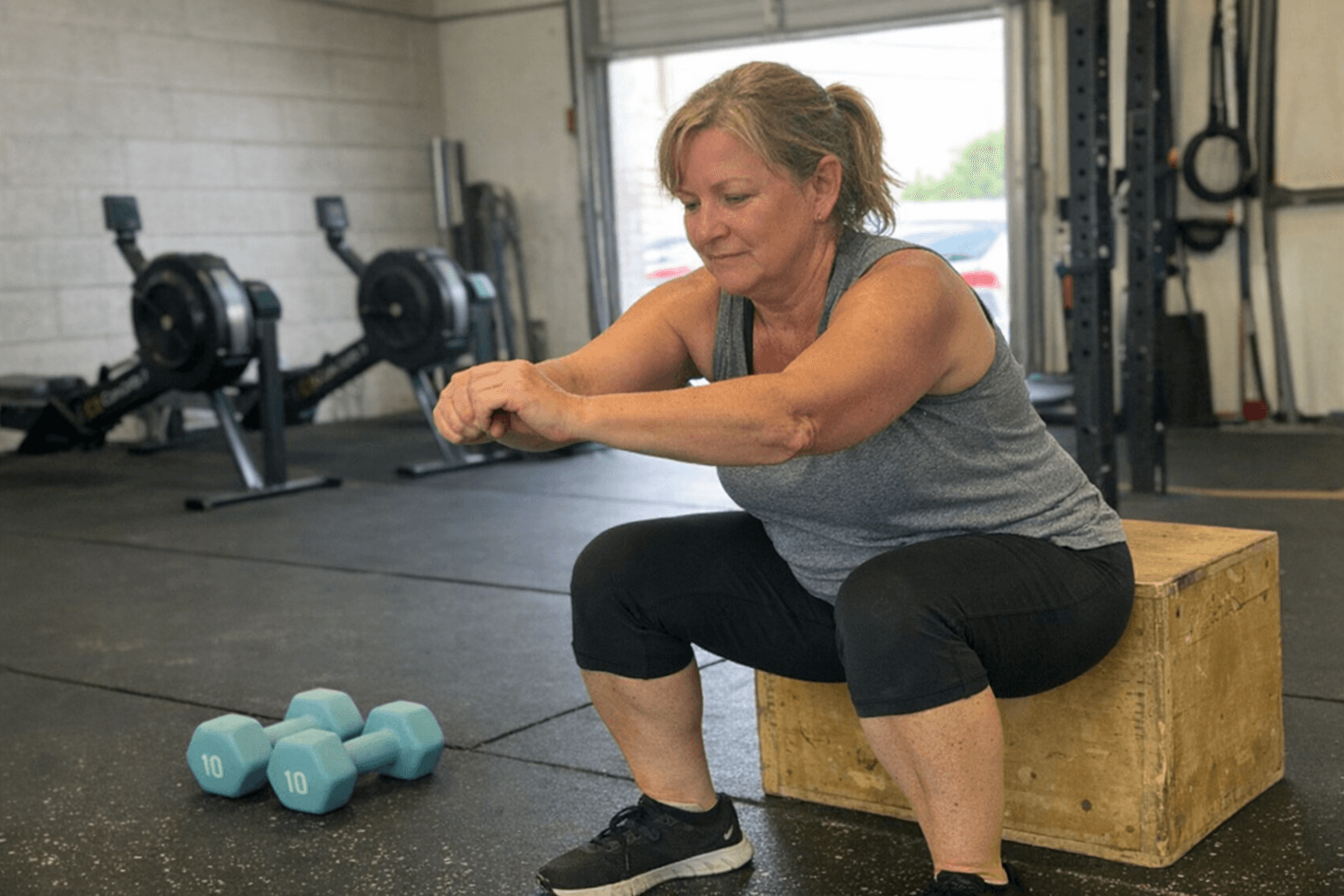
- box squats to a pain-free depth
- split squats with support instead of full-range lunges
- bike or row instead of running and jumping
- sled pushes instead of impact-heavy conditioning
- step-ups to a lower box instead of box jumps
- deadlift or hinge-focused work if squat volume is the issue
- slower tempo reps so you can control the position
- shorter range of motion while you build tolerance back up
That is not backing off forever. That is training with a plan.
If you want a clearer picture of what coaches are actually supposed to do in class, read What Does a CrossFit Coach Do?. A good coach is not just starting the clock. They are watching movement, making judgment calls, and adjusting the workout to fit the human in front of them.
Why strength training often helps knee pain instead of causing it
A lot of adults are scared to load a painful knee. That makes sense. But many knees get more irritable because the body around them is underprepared, not because all movement is bad.
Think about the typical adult who walks into a gym in Duluth:
- has spent a lot of time sitting
- maybe used to play sports but has not trained consistently in years
- walks, hikes, bikes, skis, or chases kids around, but does not do much focused strength work
- notices stairs, downhill trails, and getting off the floor feel harder than they used to
That person usually does not need less movement forever. They usually need better movement and more support around the knee.
When training is scaled well, strength work can help by improving:
- glute and hamstring strength
- quad strength without chaotic loading
- balance and single-leg control
- ankle and hip function
- confidence bending, squatting, stepping, and carrying things
- tolerance for everyday life, not just workouts
This is especially important in Duluth, because a lot of adults want to keep hiking, skiing, walking trails, and staying active outside. The goal is not just “my knee hurts less during class.” The goal is “my knee is less of a problem in real life.”
What training around knee pain actually looks like
Here is the practical version.
1. We figure out what actually bothers it
Not every squat hurts. Not every lunge hurts. Not every step-up hurts. Not every range of motion hurts.
Sometimes the issue is impact. Sometimes it is volume. Sometimes it is depth. Sometimes it is only one leg at a time. Sometimes it is the day after, not during.
That matters, because “bad knee” is too vague to build a smart plan.
2. We keep what is trainable
You can almost always keep building something:
- upper-body strength
- hinge patterns
- conditioning without impact
- core work
- carries
- controlled squat patterns
- assisted single-leg work
- tempo work and isometrics
The goal is to avoid the mental spiral of “I guess I just cannot work out right now.”
3. We pull back from the stuff that keeps poking the bruise
This is the ego part.
If your knee lights up every time you jump onto a box or rip through fast air squats, doing more of that usually is not the brave move. It is just stubborn.
We swap it, reduce it, slow it down, or dose it differently.
4. We rebuild gradually
Better knees usually come from stacking boring wins:
- cleaner reps
- better positions
- less wobble
- more control
- small increases in range, volume, or load over time
That is not flashy. It works anyway.
Does CrossFit mean a bunch of deep squats and box jumps forever?
Not unless the coach is asleep.
CrossFit is a training system. It is not one specific list of movements you must do exactly one way no matter what your knee says.
For a lot of adults with knee pain, the most useful pieces are:
- controlled squatting
- strong posterior chain work
- sleds
- carries
- rowing and biking
- step-up progressions
- single-leg balance and control
- learning how to load the legs without panic
The internet likes to reduce CrossFit to the loudest possible examples. Most adults at CrossFit Aerial are not trying to become Games athletes. They are trying to get stronger, feel better, and stay capable.
This matters even more for adults over 40 and our Legends crowd
A lot of people assume knee pain means they are too old for this kind of training. Usually that is not true.
It usually means you should stop training like recovery does not matter.
For adults over 40, over 55, or in our Legends community, the real wins are things like:
- getting off the floor more easily
- walking downhill without bracing for pain
- hiking with more confidence
- climbing stairs without thinking about it
- getting stronger around old aches instead of shrinking your life around them
That is why CrossFit for Legends: Why It’s Never Too Late to Start in Duluth matters. Strength, balance, and confidence still matter later in life. Arguably they matter more.
What about soreness versus pain?
Some soreness is normal when you start or return to training. Pain that feels wrong is different.
That line matters.
- a little muscle soreness after doing work you have not done in a while is normal
- joint pain that keeps escalating is not something to ignore
- a good coach helps you tell the difference before a small issue turns into a bigger one
If that distinction still feels fuzzy, read How Sore Should You Be After CrossFit?. It helps people stop treating every uncomfortable sensation like the same thing.
If you already deal with other aches, the same logic applies
A sore knee does not always live alone. A lot of adults who have knee issues also have stiff hips, tight ankles, a cranky back, or an irritated shoulder from years of normal life.
The pattern is often the same. Your body is not broken. It is undertrained in a few important places and overusing others.
If that sounds familiar, CrossFit for Shoulder Pain is worth reading too. Different joint, same basic idea: smart coaching beats all-or-nothing thinking.
What to look for in a gym if your knee hurts
Not every gym is set up well for this.
You want a place that:
- asks questions before throwing you into a workout
- watches how you move instead of just demoing and walking away
- treats scaling as normal
- can explain why they are changing something for you
- understands that beginners, older adults, and people coming back from a long layoff are normal, not annoying
- helps you progress instead of just survive class
That is also part of the money conversation. A cheap gym where you are on your own might look like the budget option, but if you are guessing through pain, skipping workouts, or losing momentum every time your knee flares up, it gets expensive fast.
If you want the straightforward range, coached training like this usually sits around $100 to $200 per month depending on setup. You can see the details on our pricing page.
So, can you do CrossFit with knee pain?
Often, yes.
Not by pretending pain is fake. Not by forcing jumps because the workout says jumps. Not by trying to win the day while your knee is clearly losing the argument.
But with smart coaching, good scaling, and a little patience, a lot of adults can keep training and build a more capable knee than they started with.
That is the point.
You do not need a gym that expects perfection. You need one that can meet you where you are, help you work around the issue when needed, and keep moving you forward.
If that is what you are looking for, book your first class or reach out here. We will help you figure out what makes sense for your knee, your current fitness level, and your real life.
FAQ
Can I do CrossFit with knee pain?
Often, yes. Many adults can keep training if movements are scaled well, impact is adjusted, and the goal is to build strength without feeding the problem.
Should I stop squatting if my knee hurts?
Not always. Sometimes changing the depth, tempo, volume, or squat variation works much better than avoiding squats completely.
What movements usually bother knee pain the most?
For many people, it is impact, fast high-volume squats, jumping, running, or ranges they cannot control yet. The exact trigger depends on the person.
Is CrossFit bad for older adults with knee pain?
Not if it is coached well. For many adults over 40 or 55+, scaled strength work can improve confidence, balance, and everyday function.
Is paying for coached training worth it if my knee already hurts?
Often, yes. A lot of adults do better with structure, scaling, and coaching than with trying to guess through knee pain on their own.
First, knee pain is common, but it is not all the same?
“Knee pain” covers a lot of ground.
The worst options are usually all or nothing?
Most people make one of two mistakes.
Mistake one: stop everything?
They stop squatting, stop training, stop showing up, and lose momentum. Then they come back weaker, stiffer, and more cautious than before.
Mistake two: ignore the message?
They keep doing the same jumps, the same depth, the same loading, and the same pace, hoping the knee magically gets the hint.
Good coaching gives you options, not pressure?
A good class does not act like scaling is failure.
Why strength training often helps knee pain instead of causing it?
A lot of adults are scared to load a painful knee. That makes sense. But many knees get more irritable because the body around them is underprepared, not because all movement is bad.