Strength Training for Fall Trail Running in Duluth
Tuesday, Jun 23rd, 2026Strength Training for Fall Trail Running in Duluth
Fall trail running in Duluth sounds romantic until your ankles are cooked, your quads are wrecked from the descents, and every uphill feels twice as steep as it did in your head.
That is part of the fun, but it also explains why a lot of runners hit the trails all September, feel beat up by October, and assume that is just how trail season goes.
It does not have to.
If you want to enjoy miles on the Superior Hiking Trail, Chester, Piedmont, or Hawk Ridge without feeling trashed after every run, strength training helps more than most runners think. Not because you need to become a powerlifter. You do not. You just need stronger legs, steadier ankles, and enough durability to handle hills, roots, rocks, and long downhills.
If you already liked our guides on Running in Duluth, Why Strength Training Helps Runners, or the Duluth Outdoor Guide, this is the next layer. Same city, same trails, just a better engine underneath you.
Why fall trail running hits differently
Road running is repetitive. Trail running in Duluth is not.
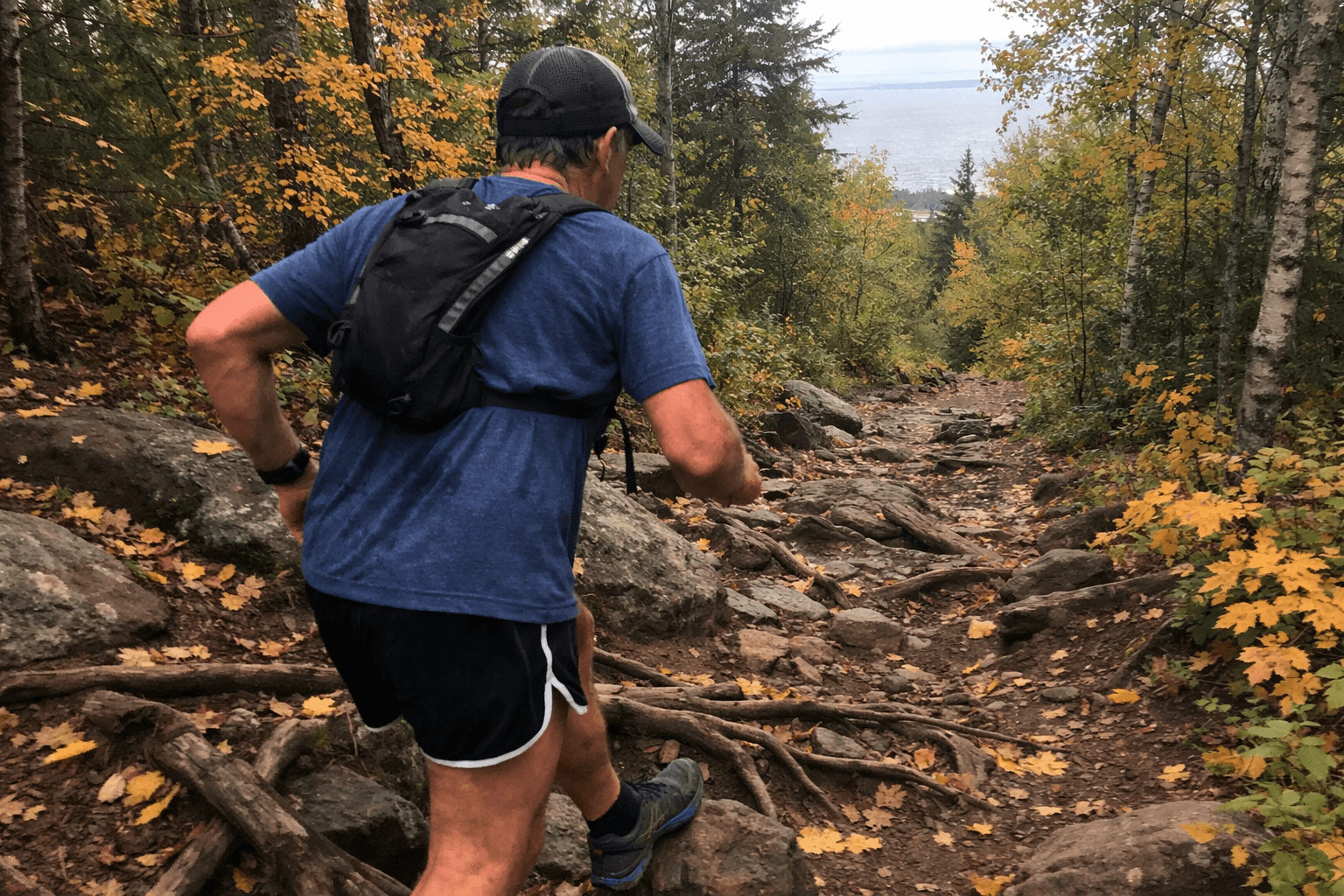
One minute you are climbing. The next minute you are picking your way through rocks, hopping roots, or braking hard on a downhill because wet leaves are hiding the trail. Your heart rate climbs fast, your footing changes constantly, and little weak links get exposed in a hurry.
That is why trail runners usually do not get limited by motivation first. They get limited by things like:
- ankles and feet that feel unstable on uneven ground
- quads that get smoked on descents
- hips that stop helping on climbs
- low backs that tighten up late in a run
- lungs that are fine on flat ground but fall apart on repeated hills
None of that means you are bad at running. It usually means your body would like a little more strength behind the mileage.
The three big weak links for Duluth trail runners
1. Downhill durability
A lot of people think the climb is the hard part.
Sometimes it is. But in Duluth, the descents do plenty of damage too.
Running downhill asks your quads, knees, and trunk to absorb force over and over while you stay balanced on uneven terrain. If you are not strong enough for that, you end up with heavy legs, sloppy foot placement, and that cooked feeling that can turn a fun trail run into survival mode.
Squats, split squats, step-downs, lunges, and controlled tempo work all help because they teach your legs to absorb force instead of just getting punished by it.
2. Ankles and single-leg stability
Trail running is basically a long series of single-leg decisions.
Every step asks your foot, ankle, calf, hip, and trunk to react fast. If one link is lazy, the rest of the chain pays for it.
That is why single-leg work matters so much. Step-ups, single-leg RDLs, split squats, calf raises, and balance work are not glamorous, but they help you stay more stable when the trail gets weird.
3. Climbing strength that actually lasts
The climbs around Duluth are short enough to tempt you into charging them and steep enough to remind you that was a bad plan.
You need enough leg strength and aerobic support to keep pushing uphill without your form falling apart. That does not mean endless suffering workouts. It means consistent strength work plus enough conditioning that repeated climbs stop feeling like a full-body emergency.
What to train if you want to feel better on fall trails
You do not need a trail-running-only gym program. You just need to cover the basics well.
Single-leg strength
This is near the top of the list for a reason.
Trail running is rarely symmetrical. Single-leg work helps your hips, knees, and ankles handle uneven ground better, and it usually exposes side-to-side gaps you would never notice on flat pavement.
Good options:
- step-ups
- walking lunges
- split squats
- single-leg RDLs
- lateral lunges
Posterior chain work
Your glutes and hamstrings matter a lot for climbing, posture, and late-run durability.
Deadlifts, kettlebell swings, hinging patterns, sled work, and loaded carries all help you stay stronger through the middle and backside of your body. That matters when you are driving uphill or trying to hold form after forty minutes on technical terrain.
Trunk strength
Trail runners do better when their torso can stay organized while the legs do chaotic things underneath it.
Carries, planks, dead bugs, anti-rotation work, and front rack positions all help. You do not need six-pack training. You need the kind of trunk strength that keeps you from folding over when the hills stack up.
Easy and moderate conditioning
Not every workout needs to feel like a race.
Zone 2 work, longer row or bike pieces, incline walks, and mixed-modal conditioning all help build the engine that makes hilly trail runs feel more manageable. If you are only ever running hard, your trails will eventually start feeling harder than they should.
Where CrossFit-style training fits
This is the part a lot of runners miss.
Good CrossFit-style training does not replace your running. It supports it.
You still need time on trails. You still need mileage that makes sense for your season. But two to four smart strength and conditioning sessions per week can make you feel a whole lot more durable on the trail. Better climbing posture. Less downhill breakdown. Fewer nagging little issues in the feet, knees, hips, and back.
That is one reason runners around here often do well with a mix of trail miles and coached group training. You get stronger, you keep the conditioning up, and you do not have to invent every workout yourself.
If you are newer to this kind of training, What to Expect Your First Week at CrossFit is the best place to start. Nobody needs to show up already fit. Most people at CrossFit Aerial are starting from way closer to zero than they admit.
If you are over 40, strength matters even more
A lot of Duluth runners are not twenty-two and chasing college PRs. They are parents, working adults, or outdoor people who just want to keep doing cool stuff without getting sidelined every six weeks.
That is exactly where strength training shines.
It helps you keep muscle, maintain balance, handle impact better, and stay more capable for the long haul. That is the same reason our CrossFit for Longevity page resonates with so many adults, and why our CrossFit for Legends article matters. The goal is not just fitness for this month. It is still being able to move well years from now.
A simple week for a trail runner
If your goal is to feel better on the trails this fall, a week like this is enough for a lot of adults:
- 2 strength sessions focused on single-leg work, hinging, carries, and trunk strength
- 1 to 2 easier trail or road runs
- 1 harder hill or trail effort
- extra walking, biking, or rowing when life is hectic and recovery matters
That is manageable for working adults. It is also a lot more realistic than pretending you are about to train like a professional in the middle of school drop-offs, work, and regular life.
You do not need to become a runner first
Maybe you are trail-curious but not already a runner. That is fine too.
A lot of people in the gym get interested in local outdoor stuff because they finally feel physically capable enough to try it. The same base that helps with hiking, snowshoeing, paddling, and the rest of Duluth life also helps with trail running. That is why this fits so naturally beside Strength Training for Hiking in Duluth and the Outdoor Guide.
You do not need a perfect training background. You just need a body that is getting stronger and a plan that meets you where you are.
The real goal
The goal is not to win the parking-lot conversation about vertical gain.
The goal is to enjoy fall trail running more.
More confidence on rocky descents. Better pop on climbs. Fewer tweaky ankles. Less soreness that bleeds into the rest of your week. More chances to say yes when friends want to get outside.
That is what strength training is for.
If you want help building that kind of fitness, check our pricing. CrossFit Aerial works with plenty of adults who have not worked out in years, need everything scaled, and still want to feel stronger for real life outside the gym.