Strength Training for Ice Skating in Duluth
Tuesday, Jun 30th, 2026Strength Training for Ice Skating in Duluth
Ice skating looks smooth right up until your ankles start wobbling, your hips light up, and you realize fifteen minutes on the ice feels longer than it should.
That is true whether you are taking kids to open skate, heading out for a date-night lap, or getting back on skates after a bunch of years away.
If you live in Duluth, skating is just part of winter life. The problem is that winter activities have a way of exposing whatever your body has not been practicing. Balance. Hip strength. Single-leg control. A little power. A little stamina. Suddenly all of it matters.
That is where strength training helps.
Not because you need to turn skating into a serious training project. You do not. You just want your body to feel steadier, more comfortable, and less cooked after a fun winter outing.
If you liked our pieces on winter fitness in Duluth, strength training for hockey in Duluth, strength training for snowshoeing in Duluth, or the Duluth outdoor guide, this fits right into that same lane.
What ice skating actually asks from your body
Skating is balance plus repeated leg drive on a slippery surface.
You are spending a lot of time on one leg, pushing sideways, controlling small wobbles, and staying in a slightly bent position that asks more from your hips and trunk than most adults expect.
That usually exposes a few things fast:
- ankles that feel shaky the second the ice gets slicker than expected
- hips and glutes that get tired from holding position and pushing sideways
- feet and calves that light up early
- low backs that get cranky from staying folded over too long
- confidence that disappears once balance starts to go
That does not mean you are bad at skating. It usually means skating asks for a mix of balance, hip strength, and coordination that desk life does not train very well.
The three big weak links for most adults
1. Single-leg balance and ankle control
Skating is basically one long series of tiny balance checks.
Every push, glide, and turn asks you to control your body over one foot without panicking when things get a little unstable. If your ankles are weak or your hips are not helping, the wobble tends to travel upward.
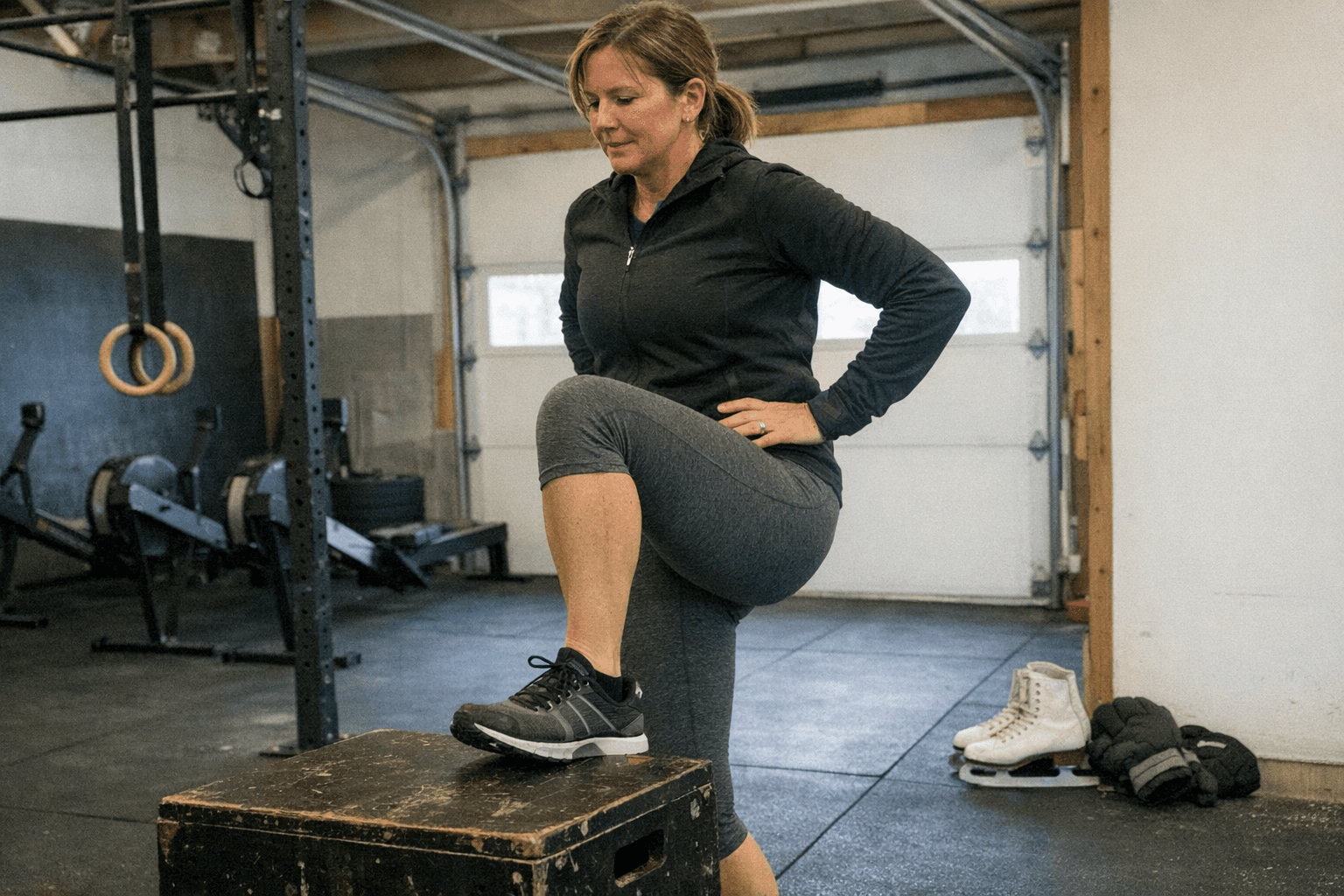
That is why step-ups, single-leg RDLs, split squats, and simple balance drills carry over so well. They teach you to own one side at a time.
2. Hip strength for push and control
A lot of the work in skating happens at the hips.
You need glutes and adductors that can create sideways force, then pull you back under control for the next stride. If that system is underbuilt, your skating gets choppy fast and your low back or knees often start doing cleanup work.
That is why split squats, lateral lunges, squats, and controlled side-to-side work matter so much.
3. Trunk strength that keeps you from folding
Most adults think the problem is just their legs.
Sometimes it is. But a lot of skating fatigue is posture fatigue. Once your trunk gets tired, you start collapsing forward, balance gets worse, and every stride feels sloppier.
Carries, rows, deadlift variations, and anti-rotation work help because they build the kind of steady control that keeps the rest of you organized.
What to train if you want skating to feel better
You do not need some fancy skater-only workout.
You need a simple strength plan that supports balance, leg strength, and control.
Step-ups and split squats
These are great because they build single-leg strength without a ton of complexity.
They help with control, knee tracking, and hip strength, which all matter once you are pushing off and catching yourself over and over on the ice.
Lateral work
Skating is not a straight-ahead sport.
Lateral lunges, skater steps, Cossack squat variations, and side-to-side control drills help because skating asks you to produce force sideways, not just up and down.
Carries and trunk work
Farmer carries, front rack carries, and simple core work help you stay braced without getting rigid.
That matters more than people think. A better trunk usually means better balance and less low-back nonsense once you have been out there a while.
Conditioning that does not wreck you
Most adults do not need all-out chaos conditioning for skating.
You are better off building a steady engine with rowing, biking, walking, or mixed intervals that improve your legs and lungs without beating your joints up. Skating is more fun when you are not huffing after every lap.
Why this matters so much for regular adults in Duluth
A lot of adults here are not training for competition.
They just want to enjoy winter more.
That could mean feeling steady enough to skate with your kids. Not dreading the first open-skate outing of the season. Feeling less stiff and awkward when friends want to do something outside. Keeping winter from shrinking your life down to work, errands, and waiting for spring.
That is why this kind of training matters. It keeps outdoor life more available.
Most people at CrossFit Aerial are not coming in with a huge fitness base. They are working parents, busy professionals, adults starting over, and plenty of people who have not worked out in years. If that is you, good. You are normal. What to Expect Your First Week at CrossFit shows how we actually ramp people in.
If you are 40, 50, or older, this is a confidence play too
Skating gets more fun when you trust your body.
That is especially true if you are not twenty anymore and a fall sounds a little less funny than it used to. Better balance, stronger hips, and more control do not just help performance. They help confidence.
That is the same reason our Legends article connects with so many people. The goal is not to be extreme. The goal is to stay capable enough to keep saying yes to the things you enjoy.
A simple week that helps
If you want skating to feel better this winter, a week like this is enough for a lot of adults:
- 2 to 3 strength sessions with squats, split squats, hinges, rows, and carries
- 1 conditioning day with rower, bike, incline walk, or a longer steady circuit
- regular walking so winter movement does not feel like a shock
- optional skating, hiking, or other outdoor time when weather lines up
That is realistic.
It also works better than waiting until January, skating once, and deciding winter activities are not for you anymore.
Skating pairs well with general fitness, not perfect skating technique
A lot of adults think they need lessons, better skates, or more confidence before they will enjoy skating again.
Sometimes that is true.
But a lot of the time, what really helps is getting generally stronger first. Better hips. Better balance. Better stamina. Less fear that your body is going to feel sketchy the whole time.
That is one reason people who train consistently tend to enjoy more of what Duluth offers outside the gym. The gym is not the point. The point is that your body is more ready for the rest of your life.
The real goal
The goal is not to become a skating specialist.
The goal is to make winter feel more open.
Better balance. Stronger hips. Less ankle panic. Less low-back fatigue. More energy to skate a little longer, move a little better, and actually enjoy the outing instead of just surviving it.
That is what good strength training is for.
If you want help building that base, check our pricing. CrossFit Aerial works with regular adults, including plenty who are starting from zero, and everything is scaled so you can build real strength without pretending you are already in winter-sport shape.