CrossFit vs Orangetheory
Tuesday, Mar 24th, 2026If you're looking at group fitness options in Duluth, you've probably narrowed it down to a few choices. CrossFit and Orangetheory come up a lot, and for good reason. They're both coached, both community-driven, and both a big step up from wandering around a globo gym by yourself.
But they're different in some pretty important ways. Here's a fair breakdown so you can figure out which one actually fits what you're after.
What Orangetheory Actually Is
Orangetheory Fitness (OTF) is a heart-rate-based group workout. You wear a monitor, and your heart rate zones show up on screens around the room. The class is structured around spending time in specific zones, with the goal of hitting the "orange zone" (84-91% of your max heart rate) for 12-20 minutes per class.
A typical class is about 60 minutes. You rotate between treadmill running, rowing, and floor exercises with dumbbells and bodyweight movements. The coach guides you through the template, which changes daily. The floor work includes things like dumbbell presses, lunges, and core work.
It's a solid cardio workout. The heart rate tracking gives you data, the music is loud, the energy is high. If you love running and want a structured cardio session with some strength work mixed in, OTF does that well.
What CrossFit Actually Is
CrossFit is a strength and conditioning program that uses constantly varied functional movements performed at high intensity. That's the textbook definition. In practice, it means every day is different. You might do heavy back squats on Monday, a fast bodyweight workout on Tuesday, and Olympic lifting combined with gymnastics on Wednesday.
Classes at CrossFit Aerial are typically 60 minutes. They include a warm-up, skill or strength work, a workout (the "WOD"), and a cool-down. The equipment list is bigger: barbells, kettlebells, pull-up rigs, rings, rowers, bikes, jump ropes, medicine balls. There's a lot of vocabulary that comes with it, which can feel overwhelming at first but clicks quickly.
The coaching is hands-on. Your coach knows your name, your movement history, and what you should be lifting today. Everything scales to your ability, so the same workout works for a college athlete and a 83-year-old retiree.
The Big Differences
Strength Development
This is probably the biggest gap between the two. Orangetheory is primarily a cardio program with some strength accessory work. The dumbbells on the floor are useful, but you're not going to build serious strength doing dumbbell rows at moderate weight for time.
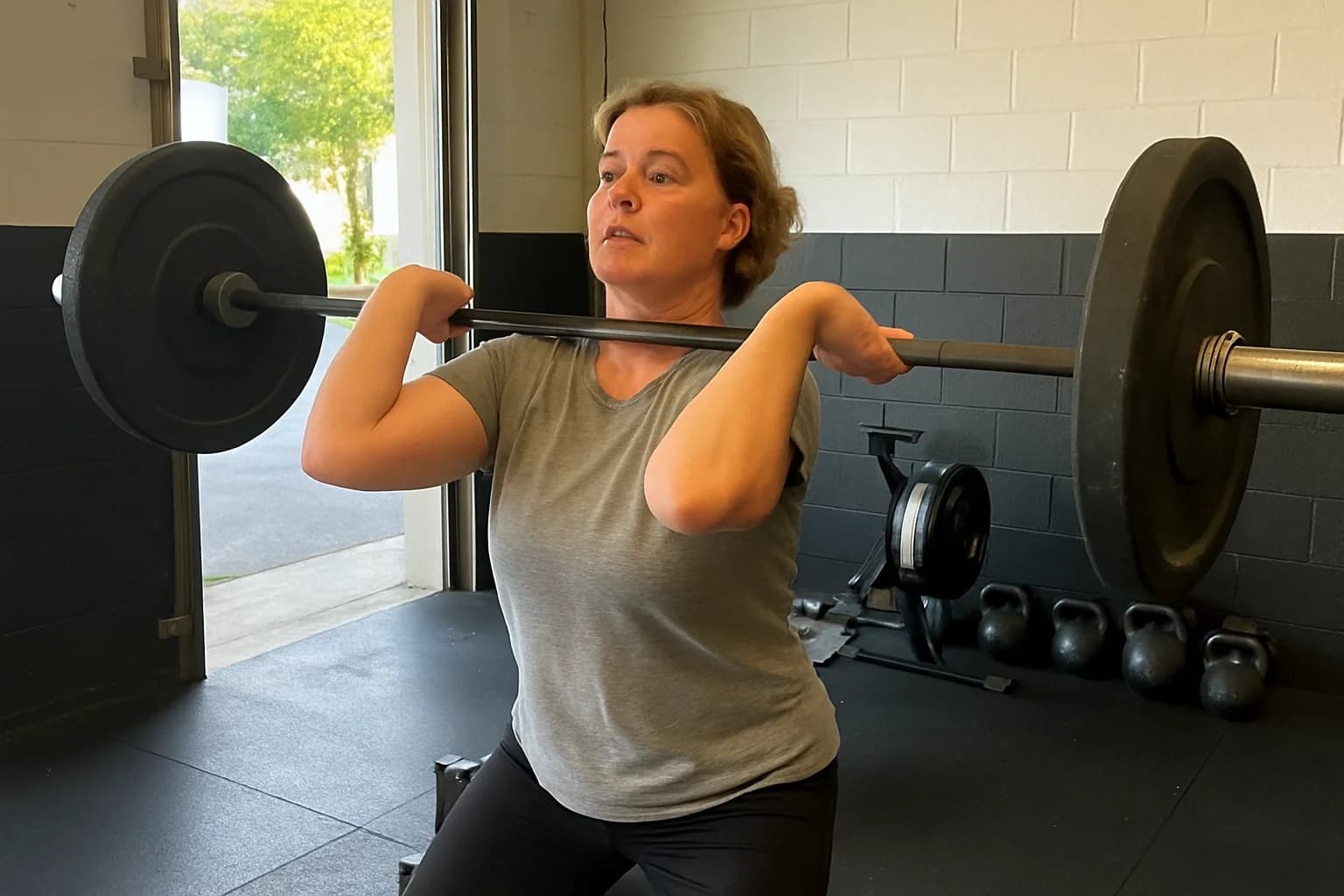
CrossFit programs dedicated strength work into nearly every class. Back squats, deadlifts, overhead presses, Olympic lifts. You track your numbers, progress over weeks and months, and hit PRs. The barbell work is a core part of the program, not an add-on.
If getting stronger is a priority for you, this difference matters a lot. Rikki, one of our members, is in her 40s and works a desk job. She's hit deadlift PRs she never imagined. That kind of strength development isn't part of the OTF model.
Movement Variety
OTF follows a template structure. The exercises rotate, but the format stays consistent: treadmill, rower, floor. You'll see similar movement patterns repeated regularly. That predictability is a feature for some people and a drawback for others.
CrossFit programming includes hundreds of different movements across weightlifting, gymnastics, and conditioning. Pull-ups, handstand push-ups, rope climbs, box jumps, muscle-ups, barbell cleans, snatches, kettlebell swings. You're constantly learning new skills. Katie, who'd been with us about six months, got her first rope climb. She never would have tried that in a traditional gym.
The skill development piece is something CrossFit offers that most other group fitness programs don't. You're not just getting a workout. You're getting better at actual physical skills over time.
Programming Depth
OTF programming is designed centrally and distributed to all locations. Every OTF in the country does the same workout on the same day. This means the programming is generalized. It has to work for every location with the same equipment and format.
CrossFit affiliates write their own programming or choose from several programming providers. At CrossFit Aerial, our programming is designed with our specific members in mind. We know who's coming, what they need, and how to progress them. There's a thought process behind why Tuesday's workout follows Monday's, and how the week builds toward specific adaptations. Your coaches are deeply involved in this process.
Coaching Style
Both OTF and CrossFit have coaches in every class. But the coaching model is different.
OTF coaches guide you through the template and keep energy high. Classes can have 20-30+ people. The coach is managing a room, cueing transitions, and monitoring heart rate zones on the screen. There's less opportunity for individual movement correction with that many people.
CrossFit classes tend to be smaller. At CFA, we keep class sizes manageable so coaches can actually watch your movement, correct your form in real time, and scale things appropriately. If your squat depth is off, they'll catch it. If you're going too heavy, they'll tell you. That kind of attention is what keeps people safe and progressing.
Scaling
Both programs offer modifications, but CrossFit's scaling system is more developed. Every movement has multiple scaling options based on ability, and coaches actively choose the right scale for each person in class. It's not just "go lighter." It might be a completely different movement that trains the same pattern at your level.
This is how we have members in their 40s and 50s training alongside 25-year-olds in the same class. Everyone gets the stimulus they need. Arvid is 83 and trains in our Legends program. He does CrossFit. It just looks different than it does for someone half his age.
Community
Both have strong communities. This is actually one of the biggest things they share. Showing up to a coached group class where people know your name beats a solo gym session for most people.
CrossFit communities tend to be tighter because of the shared suffering element. When you've done a brutal workout together and you're all lying on the floor afterward, that bonds people. Our members go hiking together, do cookouts, show up to each other's life events. Lars trained alone for years, lost motivation, and came back to CrossFit specifically because of the community accountability. He needed people who noticed when he wasn't there.
OTF communities exist too, and some locations build a real culture. But the class sizes and format make it a bit more anonymous by nature.
Cost Comparison
Let's talk money. Both are more expensive than a $10/month globo gym membership, because you're getting coaching, programming, and community instead of a card swipe and some machines.
Orangetheory typically runs $100-170/month depending on your plan and location. Unlimited classes are at the higher end.
CrossFit memberships vary by affiliate but generally fall in a similar range. Here's what it costs at CrossFit Aerial if you want specifics. When you factor in the strength development, skill coaching, and individualized scaling, the per-class value is hard to beat.
The real cost comparison is what you get for the money. If you're paying for cardio with some floor work, OTF delivers that. If you're paying for a complete fitness program that builds strength, skills, conditioning, and mobility, CrossFit delivers more.
Who Should Choose Orangetheory
OTF is a great fit if you love running and want a structured, data-driven cardio workout. If heart rate training excites you, if you like consistency in format, and if strength isn't your primary goal, OTF makes sense. It's also a good option if you prefer a larger group atmosphere with louder music and a more predictable workout structure.
No shade at all. It's a good program for what it does.
Who Should Choose CrossFit
CrossFit makes more sense if you want to get stronger, learn physical skills, and have a well-rounded fitness program. If you're bored easily, you'll love the variety. If you want a coach who knows your name and your squat depth, you'll appreciate the attention. If long-term physical capability matters to you, especially functional fitness that carries over into real life, CrossFit is built for that.
It's also worth noting that CrossFit includes everything OTF offers (rowing, running, bodyweight conditioning) plus barbell work, gymnastics, and Olympic lifting. The conditioning piece is baked in. You just also get the strength and skill development on top of it.
The Bottom Line
Both are better than going to a gym alone and guessing. Both are coached. Both have community. The difference is what you're training for.
If cardio is your thing and you want data on your heart rate zones, try Orangetheory. If you want to get strong, learn new skills, and build all-around fitness with personal coaching, come try CrossFit. We'll meet you where you are.
Is CrossFit or Orangetheory better for weight loss?
Both can help with weight loss, but they approach it differently. Orangetheory focuses on calorie burn through sustained cardio in heart rate zones. CrossFit combines strength training with conditioning, which builds muscle and increases your resting metabolic rate. For long-term body composition change, the combination of strength and conditioning in CrossFit often produces more lasting results.
Can beginners do CrossFit or is Orangetheory easier to start?
Both are beginner-friendly. Orangetheory may feel less intimidating initially because the format is straightforward: treadmill, rower, floor. CrossFit has more of a learning curve because of the movement variety, but everything scales to your ability level. Most CrossFit gyms, including CrossFit Aerial, have intro programs specifically designed for beginners with no fitness background.
Is CrossFit more expensive than Orangetheory?
Pricing is generally similar. Orangetheory unlimited plans typically range from $100-170 per month depending on location. CrossFit memberships vary by affiliate but fall in a comparable range. The difference is in what's included. CrossFit memberships generally include strength programming, skill development, and more individualized coaching in smaller class sizes.
Does Orangetheory build muscle like CrossFit?
Orangetheory includes some strength work with dumbbells and bodyweight, but it's primarily a cardio program. CrossFit dedicates significant time to barbell strength work including squats, deadlifts, presses, and Olympic lifts. For building meaningful strength and muscle, CrossFit provides a more complete training stimulus.
Which has better community, CrossFit or Orangetheory?
Both have strong communities compared to traditional gyms. CrossFit communities tend to be tighter because of smaller class sizes and the shared experience of challenging workouts. Members often form friendships that extend outside the gym. Orangetheory also builds community, though larger class sizes make it somewhat more anonymous. The best community is the one you actually show up to.
Can I do both CrossFit and Orangetheory?
You can, though most people find they don't need to. CrossFit already includes conditioning work similar to what you'd get at Orangetheory, plus strength and skill work on top. Doing both could lead to overtraining and doesn't leave enough recovery time. If you enjoy both, try each for a month and see which one you look forward to more.