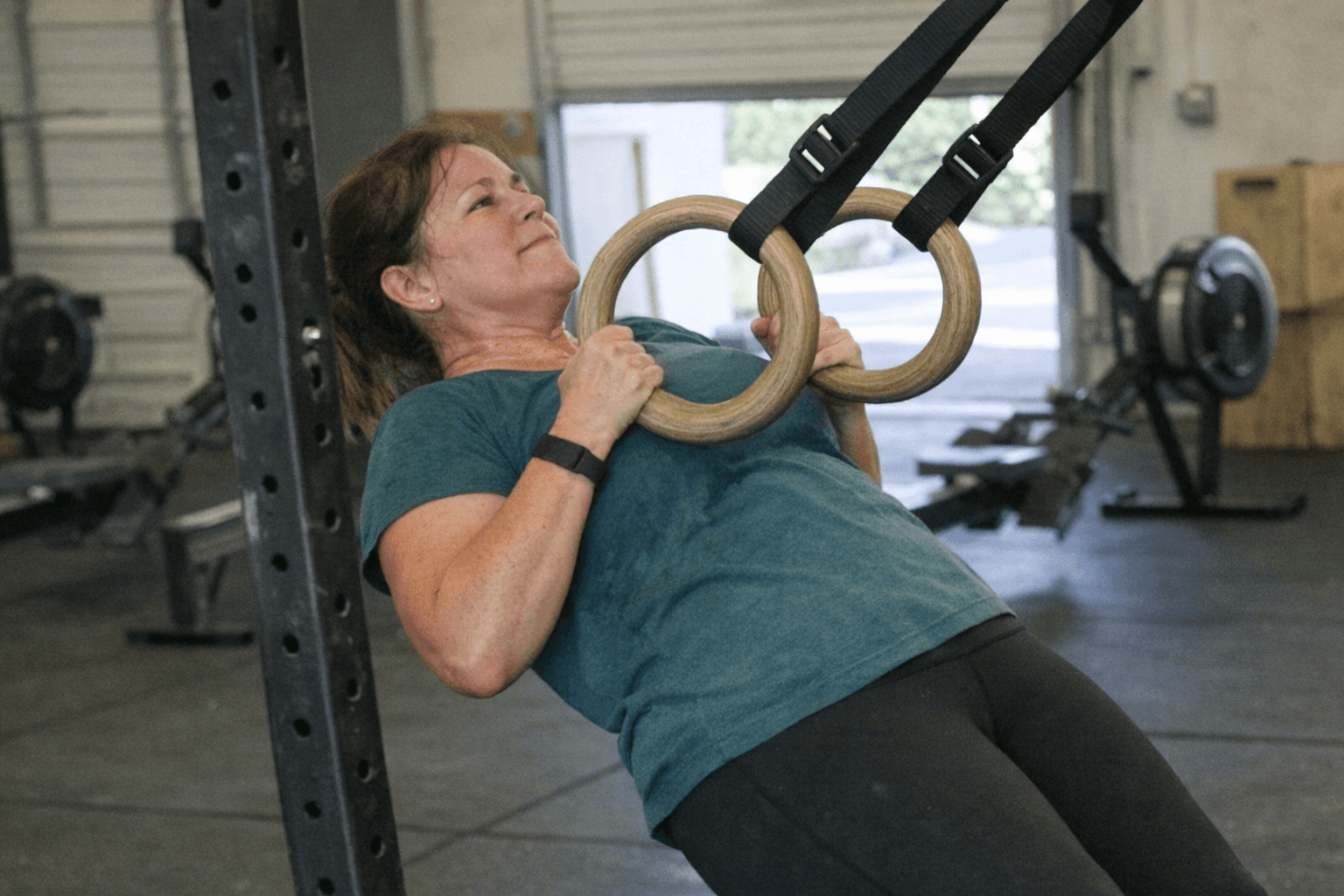
CrossFit Gymnastics Progressions
Saturday, Apr 4th, 2026If you hear the word gymnastics and immediately picture chalk clouds, handstand walks, and some former college athlete flying around a pull-up bar, fair.
That is what a lot of adults think too.
Then they walk into CrossFit and see words like pull-ups, toes-to-bar, ring rows, push-ups, hanging knee raises, or handstand holds written on the board, and they start wondering if they accidentally signed up for a circus audition.
You did not.
In CrossFit, gymnastics mostly means bodyweight movement. Can you control your body in space? Can you hang from a bar? Can you push yourself off the floor? Can you keep your ribs down, brace your midline, and move well under control?
That is good news if you are starting from scratch, because gymnastics progressions are built exactly for that.
At CrossFit Aerial, most adults are not coming in with a background in pull-ups, rope climbs, or handstands. They are working parents, people getting back into fitness after years away, and Legends members who want to stay capable. So we do not start by throwing people at the hardest version and hoping for the best. We build the pieces first.
First, What CrossFit Means by Gymnastics
In a CrossFit setting, gymnastics is not just the flashy stuff.
It includes things like:
- push-ups
- ring rows
- pull-ups
- hanging knee raises
- toes-to-bar
- dips
- rope climbs
- handstand holds
- handstand push-up progressions
The common thread is body control.
You are learning how to move your own body well, not just how to move a barbell.
That matters a lot for adults because bodyweight strength carries over into regular life fast. Getting up off the floor. Catching yourself when you trip. Carrying awkward things. Reaching overhead without feeling like your shoulders belong to somebody's grandpa.
If you are brand new to the terminology, CrossFit Terminology Glossary helps decode the weird words first.
Adults Usually Need a Different Starting Point
A lot of gymnastics content online assumes you already have a base.
It assumes you can hang from a bar for a while, hold a solid plank, and crank out some strict reps before you ever think about progressions.
That is not reality for a lot of normal adults.
If you have not worked out in years, your first progression might be simpler than you expect. It might be:
- hanging for 10 seconds
- doing ring rows at an easier angle
- pushing up to a box instead of the floor
- practicing hollow holds for short sets
- learning how to kip later, not right now
That is not a watered-down version of training. That is training.
It is the same reason we scale everything else. The goal is to meet you where you are, then build from there.
If that whole idea sounds appealing, How to Start CrossFit Even If You Haven't Worked Out in Years and What to Expect Your First Week at CrossFit both cover how that looks in real life.
The Real Foundation: Strength, Positions, and Patience
Most adults want to skip straight to the milestone movement.
They want the pull-up, the toes-to-bar, the rope climb.
Makes sense. Those are fun.
But the real progress usually comes from getting boringly good at three things first:
1. Hanging strength
Can you support your body from a bar without your shoulders creeping into your ears and your hands giving up instantly?
Before pull-ups or toes-to-bar, a lot of adults need:
- dead hangs
- active hangs
- scap pull-ups
- short, controlled sets instead of one max-effort panic hang
This is one reason grip matters so much. If your hands are the first thing to fail, How to Build Grip Strength is a useful companion to this whole process.
2. Midline control
A surprising amount of gymnastics comes down to whether you can hold solid positions.
Can you brace your trunk? Can you keep a hollow body position? Can you move your legs without your lower back taking over?
That shows up in:
- hollow holds
- dead bugs
- knee raises
- controlled beat swings
- handstand setup work
People often think they need more arm strength when they actually need better positions.
3. Pushing and pulling strength
Strict strength still matters.
Before kipping anything, most adults need to build a better base with:
- ring rows
- negative pull-ups
- box push-ups
- dumbbell presses
- dips with assistance
- tempo work
The flashy stuff gets the attention. The strict foundation is what makes it safe and repeatable.
A Simple Adult Progression for Common CrossFit Gymnastics Movements
Here is what progressions often look like in practice.
Not every person follows the exact same path, but this is the general idea.
Pull-up progression
- Dead hangs and active hangs
- Ring rows
- Scap pull-ups and lat strength work
- Negative pull-ups or banded pull-ups
- Strict pull-up attempts
- Controlled kipping work only after the basic positions exist
If pull-ups are your main target, How to Get Better at Pull-Ups goes deeper on the strength side.
Toes-to-bar progression
- Hollow holds and dead bugs
- Hanging knee raises
- Knee raises with control and tempo
- Beat swing timing
- Toes-to-bar singles
- Linking reps later
A lot of people try to force this one with momentum. Usually the faster fix is better hollow position, better hang, and smaller, cleaner reps.
Push-up progression
- Elevated push-ups on a box or bench
- Slower eccentrics
- Full plank position work
- Floor push-ups for singles
- Sets of quality reps
Push-ups count as gymnastics too. They are one of the best examples of a movement almost everyone can scale effectively.
Handstand progression
- Pike holds on a box
- Wall-facing handstand holds
- Shoulder taps or weight shifts
- Strict handstand push-up strength pieces
- More advanced handstand work only if it makes sense for your goals
For most adults, the first win is not walking on your hands. It is getting stronger overhead, building confidence upside down, and realizing your shoulders can do more than you thought.
The Mistake Adults Make Most Often
They judge their progress against somebody who has been doing this for years.
That is a fast way to feel behind.
CrossFit gymnastics has a steep-looking learning curve because advanced reps are obvious. You can see the gap. Somebody does ten unbroken toes-to-bar and you think, cool, I cannot even hang comfortably yet.
But that does not mean you are failing.
If you went from zero hanging tolerance to 20 solid seconds on the bar, that is progress. If your ring rows got steeper, that is progress. If you can finally do a real push-up off the floor, that is progress. If you learned how to keep your shoulders active instead of dangling from your joints, that is definitely progress.
Adults do really well when they treat gymnastics like skill practice, not a daily referendum on their fitness.
Why Coaches Matter So Much Here
Gymnastics movements are easy to butcher when you are guessing.
A small change in body position can make a huge difference. A better setup on the rings can suddenly make rows click. A cue about ribs, shoulders, or where to look can turn a sloppy knee raise into a useful rep.
That is one reason coached classes help so much, especially for beginners. You are not just getting a workout. You are getting a progression.
That support matters whether you are 35 and restarting fitness after kids, or 68 and trying to keep your shoulders, balance, and confidence for the long haul. If you are in the older crowd, CrossFit for Legends: Why It's Never Too Late to Start in Duluth is worth reading too.
And yes, this kind of coaching is part of what you are paying for. Not just access to equipment, but eyes on movement, smart scaling, and a plan that meets you where you are. The pricing page breaks that out more clearly.
What Progress Usually Looks Like at CrossFit Aerial
For most adults, progress is quieter than they expect.
It looks like this:
- you stop being afraid of the pull-up bar
- your shoulders feel more stable overhead
- you can hang longer without panicking
- you get your first real push-up
- ring rows go from awkward to strong
- you understand the positions instead of just flailing through reps
- one day, a movement you used to scale starts to look possible
That is the stuff that matters.
A first pull-up is cool. So is being able to get on and off the floor more easily, catch yourself on a hike, or carry your kid without feeling smoked. Gymnastics progressions help with all of that because they teach control, coordination, and usable strength.
The Bottom Line
CrossFit gymnastics progressions for adults should feel approachable, not intimidating.
You do not need a gymnastics background. You do not need to already be strong. You do not need to earn the right to start.
You just need the right starting point.
For most adults, that means building hanging strength, strict pulling and pushing, core control, and better positions before worrying about flashy reps.
That is how real progress happens. Small steps. Good coaching. Reps that match your current level. Then more options open up from there.
And honestly, that is the whole point of CrossFit done well. Take movements that look intimidating from the outside, scale them to the person in front of you, and help them do more than they thought they could.
FAQ
What are CrossFit gymnastics movements?
CrossFit gymnastics movements are bodyweight movements like push-ups, pull-ups, ring rows, toes-to-bar, dips, rope climbs, and handstand work. In practice, they are about body control, coordination, and strength.
Can adults start CrossFit gymnastics with no experience?
Yes. Most adults start with simple progressions like ring rows, box push-ups, dead hangs, and hollow holds. You do not need a gymnastics background to begin.
What is the first step to getting a pull-up?
Usually it is building hanging strength, ring row strength, grip, and shoulder control first. Most adults do not go straight from zero to strict pull-up attempts.
Should beginners kip in CrossFit?
Usually not right away. Most beginners do better building strict strength and solid positions before learning kipping mechanics.
Are gymnastics movements in CrossFit safe for older adults?
They can be very safe when they are coached and scaled well. The key is using the right progression for the person, not forcing an advanced version.
First, What CrossFit Means by Gymnastics?
In a CrossFit setting, gymnastics is not just the flashy stuff.
Adults Usually Need a Different Starting Point?
A lot of gymnastics content online assumes you already have a base.
The Real Foundation: Strength, Positions, and Patience?
Most adults want to skip straight to the milestone movement.
1. Hanging strength?
Can you support your body from a bar without your shoulders creeping into your ears and your hands giving up instantly?
2. Midline control?
A surprising amount of gymnastics comes down to whether you can hold solid positions.
What about 3. Pushing and pulling strength?
Strict strength still matters.