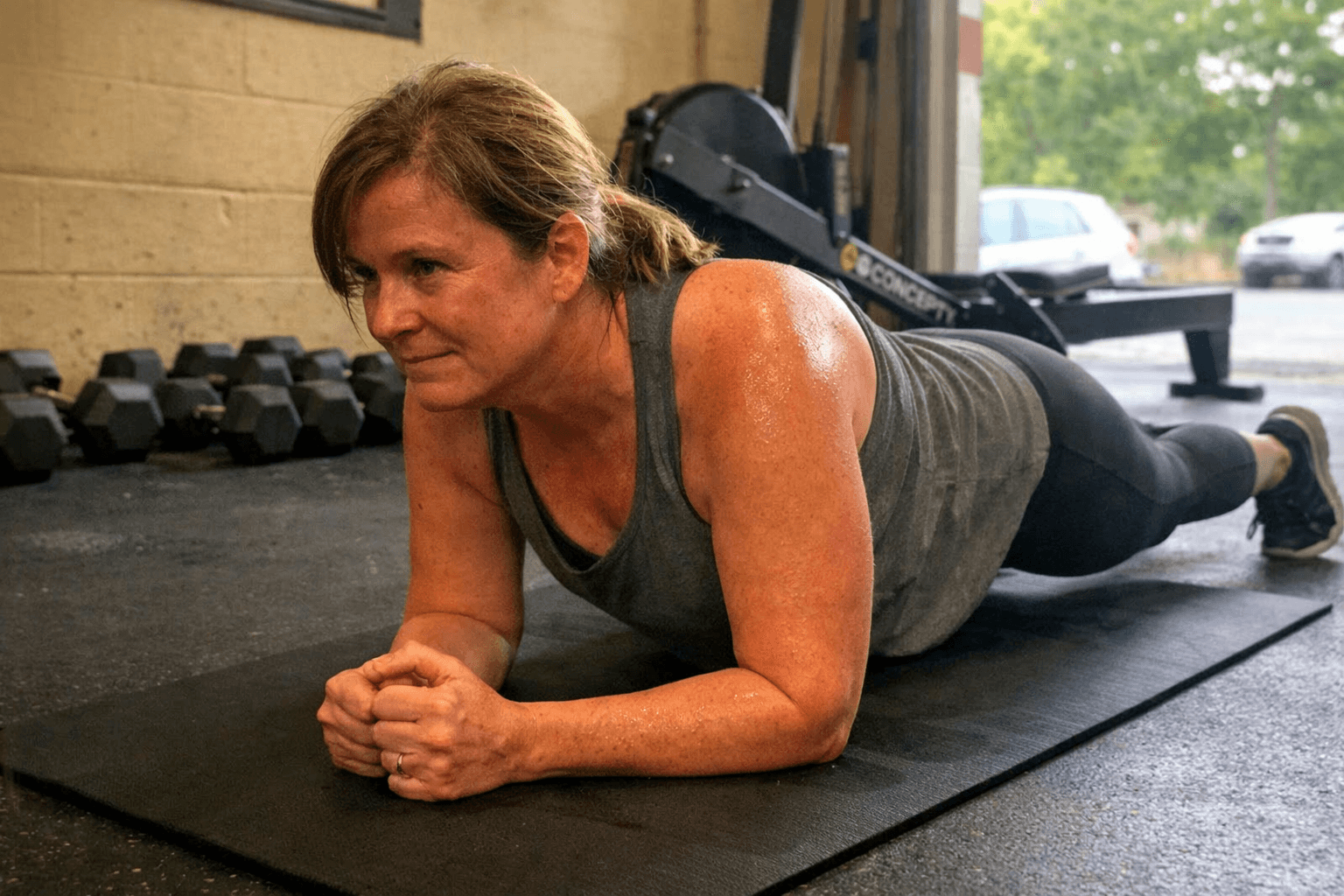
CrossFit vs Planks
Monday, Apr 6th, 2026If you only judged fitness by the internet, you would think planks are some kind of miracle.
Every few months another video pops up claiming you can fix your back, flatten your stomach, build your core, and basically become unbreakable if you just hold still on your elbows long enough.
Planks are fine.
They are not magic.
And if you are comparing CrossFit vs planks, the real answer is pretty simple. One is a single exercise. The other is a full training system.
That does not mean planks are useless. It just means they solve a much smaller problem than people think.
At CrossFit Aerial, most people are not trying to become professional fitness weirdos. They want to feel stronger, move better, lose some body fat, stop feeling wrecked by daily life, and have enough gas left to enjoy Duluth outside the gym too. Working parents. Adults starting over. Legends members. People who have not trained consistently in years.
For that crowd, the question is not really, “Are planks good?”
It is, “Are planks enough?”
Usually, no.
What Planks Actually Do Well
Planks train your ability to resist movement.
That matters.
Your core is not just there to bend and twist. A lot of its job is to keep your spine organized while the rest of you moves.
A good plank can help with:
- learning how to brace
- building basic trunk endurance
- improving awareness of rib and hip position
- giving beginners a low-skill way to feel their midline working
That is useful, especially if you are brand new to exercise or coming back after a long break.
But notice what planks do not train very well on their own.
They do not build much pulling strength. They do not improve your squat. They do not teach you how to pick something up from the floor. They do not improve your conditioning much. They do not prepare you for hauling groceries, carrying a kid, loading camping gear, or hiking up a trail in Duluth with a pack on.
Planks are one piece.
They are not the whole house.
What CrossFit Trains That Planks Do Not
CrossFit, when it is coached well, trains a lot more than one static position.
It trains:
- squatting
- hinging
- pressing
- pulling
- carrying
- rowing, biking, and conditioning
- balance, coordination, and stamina
- core strength under actual movement
That last part is the big one.
In real life, your core rarely gets tested while you are perfectly still on the floor for 45 seconds. It gets tested when you pick up a bag of dog food, shovel snow, carry a cooler, walk downhill on a trail, swing a kettlebell, get off the floor, or hold yourself together when you are tired.
That is what functional training is really about. If you want the bigger version of that idea, What Is Functional Fitness lays it out pretty clearly.
A good CrossFit class trains your trunk in context.
Front squats train you to brace while moving. Deadlifts train you to keep your spine organized while producing force. Farmer carries train your core while you walk and breathe. Ring rows and pull-up progressions force your midline to work with your shoulders and grip. Even something as simple as a rower sprint demands more real-world trunk coordination than most plank challenges on Instagram.
Are Planks Good for Beginners?
Yes.
They are just not enough by themselves.
For beginners, planks can be a good starting point because they are simple to scale. You can shorten the hold, elevate the hands, or use a box. They can teach someone what bracing feels like without asking them to learn a bunch of moving parts on day one.
That is why they still show up sometimes.
But if someone walks into CrossFit Aerial worried they need to “get in shape first,” the answer is not, “Go do planks in your living room for three months and then come back.”
The answer is to start where you are and scale real training.
That is the whole point of coaching. CrossFit for Beginners, How to Start CrossFit, and What to Expect Your First Week at CrossFit all exist because nobody is expected to show up ready.
If Your Goal Is a Stronger Core, Which One Wins?
CrossFit.
Pretty easily.
Not because planks are bad, but because your core gets stronger when it has to do more than one job.
A stronger core usually means you can:
- resist extension
- resist rotation
- transfer force between upper and lower body
- stabilize while you breathe and move
- stay organized under load
Planks mostly hit the first one.
CrossFit hits all of them, especially when you are doing carries, front rack work, unilateral loading, controlled gymnastics progressions, and basic barbell or dumbbell training.
That is why people often notice their backs feel better, their posture improves, and daily life gets easier after a few months of training. It is not because they discovered a secret ab exercise. It is because their whole system got stronger.
That idea overlaps a lot with How CrossFit Fixes Your Desk Job Body. Sitting all day usually does not require a fancy fix. It usually requires stronger hips, trunk, upper back, and better movement habits.
If Your Goal Is Fat Loss, Which One Wins?
Again, CrossFit.
Planks burn some energy, sure. But they are not driving much overall adaptation unless they are part of a broader plan.
CrossFit gives you a better fat-loss tool because it combines:
- strength work that helps preserve and build lean mass
- conditioning that challenges your engine
- coaching and scaling so you can stay consistent
- community and accountability so you do not disappear after two weeks
That last one matters more than people admit.
The best program is not the one that looks clever on paper. It is the one you will actually keep doing.
If fat loss is the lens you are using, CrossFit for Weight Loss, How Often Should You Work Out, and Is CrossFit Worth It are all more useful than another thirty-day plank challenge.
But Planks Feel Safer Than CrossFit, Right?
Sometimes they feel safer because they are smaller.
That is not the same as being more effective.
A properly coached CrossFit class for a beginner is not just chaos and max effort. At a good gym, it looks like scaled weights, controlled movement, smart progressions, and a coach adjusting the dose so you can train without getting buried.
That is true whether you are 32 and deconditioned, 47 with a desk job, or in our Legends age range and trying to stay independent for a long time.
Could someone do an ugly plank and irritate their back or shoulders? Sure. Could someone do a badly coached CrossFit workout and feel beat up? Also sure.
The point is not that one exercise is automatically safe and one program is automatically dangerous.
The point is that coaching matters.
That is why What Does a CrossFit Coach Do and Is CrossFit Dangerous are worth reading if that is your concern.
What Planks Miss for Real Life in Duluth
This part matters around here.
A lot of CrossFit Aerial members care about being fit for life outside the gym.
That means hiking, biking, skiing, paddling, carrying gear, shoveling snow, walking hills, and generally not feeling smoked by normal Duluth life.
Planks can help a little with trunk endurance.
They do not do much for:
- carrying awkward loads
- climbing hills
- getting stronger through your hips and legs
- building grip for outdoor stuff
- improving work capacity
CrossFit does.
That is why the training carries over so well to the kinds of things people here actually do. The connection is all over The Duluth Outdoor Guide, Best Beginner Hikes in Duluth, and Running in Duluth.
So Should You Stop Doing Planks?
No.
Use them for what they are.
Planks are fine as:
- part of a warm-up
- a simple core drill for beginners
- a way to relearn bracing
- accessory work alongside real training
- a low-skill option during injury modifications, when appropriate
They just should not be your entire plan unless your goal is to get better at planks.
And that is rarely the actual goal.
Most adults want to feel capable again. They want their backs to stop barking. They want stairs to feel easier. They want to keep up with their kids. They want to carry packs, groceries, mulch, hockey bags, and kayaks without feeling ancient.
That takes more than one exercise.
What We Actually Recommend at CrossFit Aerial
If someone likes planks, great.
We will use them when they make sense.
But the bigger recommendation is this:
- Learn how to brace
- Build strength through full-body movement
- Improve conditioning a little at a time
- Scale the work so you can recover and come back
- Stay consistent long enough for normal life to start feeling easier
That is what people are paying for, not just access to a room with equipment, but coaching, scaling, programming, and a community that helps them stick with it. If you want the plain-English version of that value stack, the pricing page covers it.
The Bottom Line
If the question is CrossFit vs planks, CrossFit wins for almost every real-world goal.
If the question is are planks useless, no. They are a decent tool.
They are just not a complete answer.
Planks can help you learn to brace. CrossFit helps you use that strength while moving, lifting, carrying, breathing, and living like a normal person.
So if all you have been doing is chasing longer plank holds and wondering why the rest of your body still feels weak, stiff, or underpowered, that is probably your answer.
Keep the plank if you want.
Just do not confuse one exercise with a full plan.
Are planks enough to build a strong core?
Usually no. Planks can help you learn to brace and build some trunk endurance, but they do not train full-body strength, conditioning, carrying, pulling, or core strength under movement the way a well-coached CrossFit program does.
Is CrossFit better than planks for beginners?
For most beginners, yes. Planks can be a good starter exercise, but a scaled CrossFit program gives beginners a fuller plan with coaching, progression, and conditioning that actually carries over to daily life.
Should you still do planks if you do CrossFit?
Sure, when they make sense. Planks work well as warm-up drills, basic core practice, or accessory work. They just should not be mistaken for a complete training plan.