Winter Balance Exercises
Tuesday, Aug 4th, 2026Winter Balance Exercises
If winter sidewalks make you feel a little stiff, tentative, or one bad step away from a surprise split, you are not the only one.
A lot of adults in Duluth do not really need a full winter training plan. They need a little more balance, a little more leg confidence, and a little less panic when the driveway, parking lot, or front steps get slick.
That matters for the people we see all the time at CrossFit Aerial. Working parents carrying bags and hurrying kids around. Legends members who want to stay steady and independent. Adults getting back into exercise after a long break who do not need one icy scare to shut the whole habit down.
If the bigger issue is walking technique and winter footing, start with How to Walk on Ice Safely. If gear is the real blocker, Winter Walking Gear for Duluth is the better first read. This article is about the small exercises that help your body react a little better when winter gets sketchy.
Balance in winter is not just balance
When adults say they feel wobbly on snow and ice, it usually is not one single problem.
It is a mix of things:
- ankles that do not adjust quickly
- hips that do not control side-to-side motion very well
- stiff calves and hamstrings
- legs that are strong enough in a straight line but not great on one foot
- confidence that disappears the second the ground feels slick
That last one matters more than people admit.
The second you stop trusting your footing, your body gets tense. Then your steps get choppy. Then everything feels harder than it should.
You do not need fancy balance drills
Most adults do better with simple drills they will actually repeat.
That means using a wall, countertop, rail, or chair if needed. It means starting with 20 to 30 seconds instead of trying to prove something. It means building steadiness, not showing off.
If you are starting from zero, good. That is normal here. What to Expect Your First Week at CrossFit exists for exactly that reason.
1. Single-leg stand near a wall
This is the easiest place to start.
Stand tall, lightly hold a wall or counter if needed, and lift one foot just an inch or two off the ground. Hold for 15 to 30 seconds, then switch sides.
A few things to focus on:
- keep your eyes forward
- keep your standing knee soft, not locked out
- let your toes spread inside the shoe if you are barefoot at home
- use just enough hand support to stay calm
Do 2 to 3 rounds per side.
This sounds basic because it is basic. It also works.
2. Heel-to-toe weight shifts
A lot of adults feel unstable in winter because they do not trust where their weight is landing.
This drill helps.
Stand with both feet down and slowly shift your weight from midfoot toward the balls of your feet, then back toward the heels without rocking wildly.
You are not trying to lean way back. You are just teaching your body where it is in space.
Try 8 to 10 slow reps.
If your ankles are always stiff in the cold, pair this with the prep work in Winter Warm-Ups in Duluth.
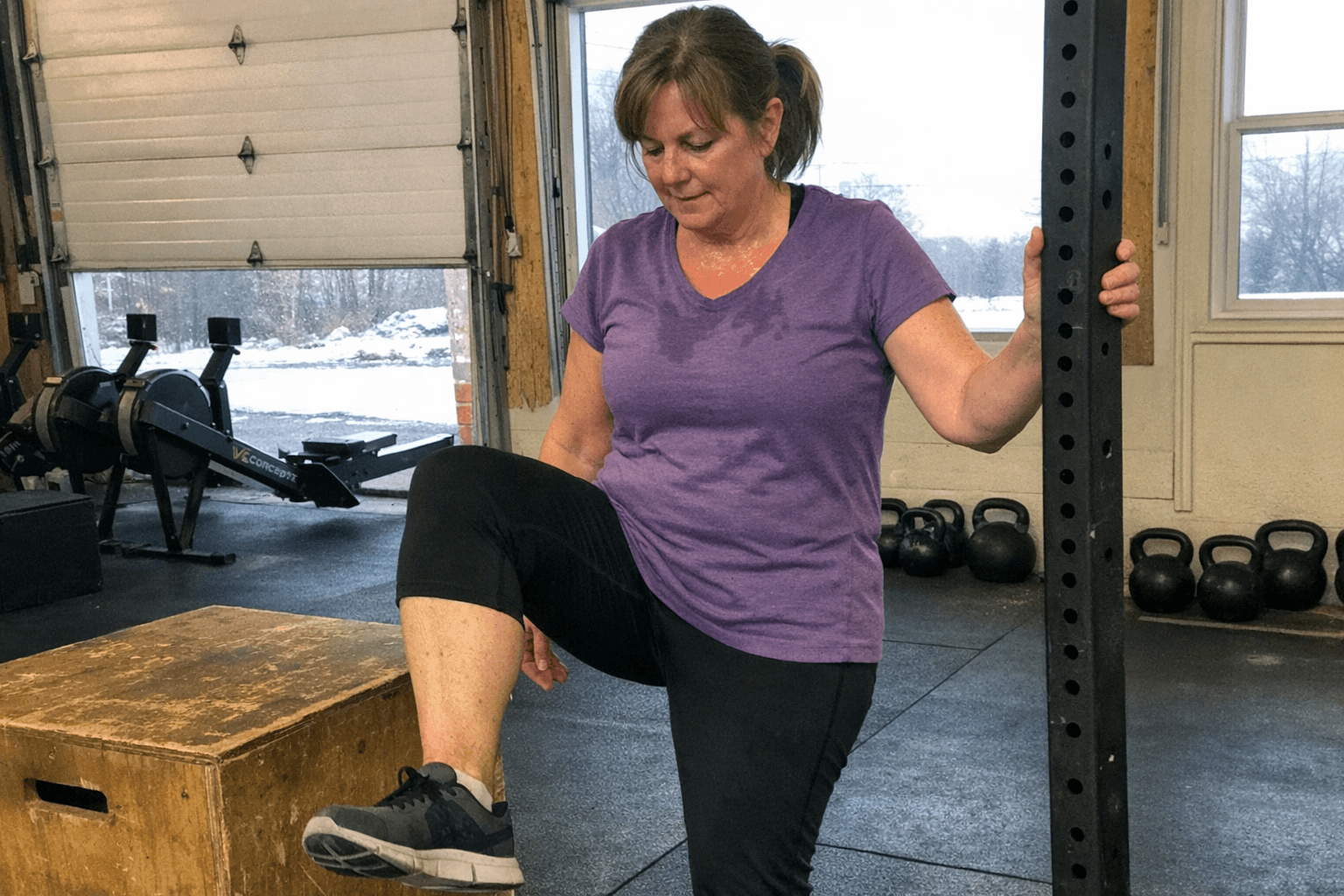
3. Marching balance holds
Marching slowly is a great bridge between standing still and actually moving.
Stand tall and bring one knee up like a slow march. Pause for one or two seconds. Set it down under control. Switch sides.
Think about:
- standing tall instead of leaning back
- controlling the pause
- landing quietly
- staying smooth, not fast
Do 8 to 12 reps per side.
This is especially useful for adults who feel okay standing still but lose it the moment they have to shift weight quickly.
4. Sit-to-stands without plopping
This one matters more than people think.
Getting up from a chair under control builds leg strength, coordination, and confidence. Those all carry over into winter life.
Sit on a chair or bench. Stand up without using momentum if you can. Then lower back down slowly.
Try 8 to 12 reps.
If that is easy, slow down the lowering part.
If it is hard, use your hands a little and keep going.
For a lot of Legends members, this is one of the best real-life exercises there is. That is a big part of why the Legends article talks so much about strength for everyday independence.
5. Step-ups on a low step
Winter footing is full of curbs, stairs, uneven snowbanks, and awkward little changes in height.
Step-ups help your body deal with that.
Use a low step. Step up with control, stand tall, then step down carefully. Switch which leg leads.
A few cues:
- keep the whole foot on the step
- drive through the leg on the step
- control the way down
- hold a railing if needed
Do 6 to 10 reps per side.
Start lower than your ego wants to.
6. Supported split squats
If single-leg strength is weak, icy ground exposes it fast.
A supported split squat helps build that strength without needing perfect balance first.
Hold onto a rail, wall, or sturdy support. Stagger your feet. Lower straight down a little, then stand back up.
You do not need a giant range of motion.
You do need:
- pressure through the front foot
- a steady torso
- slow control
- both legs working
Try 6 to 8 reps per side.
7. Side steps or lateral toe taps
A lot of slips are not forward and backward. They are side-to-side.
That is why lateral work helps.
You can do this a few ways:
- take slow side steps with a mini band if you have one
- tap one foot out to the side and back in under control
- step sideways onto a low platform and back off
Do 8 to 12 reps per side.
This helps your hips do their job when winter footing gets unpredictable.
8. Farmer carries if you want the practical version
Carrying groceries on packed snow is basically a real-life fitness test.
Farmer carries are great because they train posture, grip, trunk control, and walking rhythm all at once.
Grab two dumbbells, kettlebells, or even heavy tote bags. Walk slowly and stay tall.
Think:
- ribs down
- shoulders relaxed
- short steady steps
- eyes forward
If you are a parent hauling backpacks, groceries, or kid gear in winter, this one pays off fast.
Start with two or three drills, not all eight
You do not need a giant circuit.
Pick two or three exercises that match where you are right now. Do them three or four days a week for 10 minutes.
A simple starter plan:
- single-leg stand, 2 rounds per side
- sit-to-stands, 10 reps
- marching balance holds, 8 reps per side
- step-ups, 6 reps per side
That is enough to matter if you actually do it.
The goal is not to become a balance person
The goal is to feel steadier doing normal winter life.
Walking into work. Taking out the trash. Carrying groceries. Going for a short walk. Getting to the gym without acting like the parking lot is the main event.
That is also why these drills pair well with How to Walk on Ice Safely, because better movement strategy and a little more strength work together.
If winter has made you tentative, that does not mean you are old or broken
It usually means you need a little practice and a little structure.
At CrossFit Aerial, most adults are not coming in already fit. They are busy parents, working professionals, beginners, and Legends members who want coaching, scaling, and a place that meets them where they are.
Most people land somewhere in the $100 to $200 per month range depending on the level of support they want. What they are really paying for is coaching, accountability, programming, scaling, and a community that makes consistency easier. A lot of those friendships carry over into hikes, ski days, and other outdoor plans too. If you want the breakdown, head to the pricing page.
If you want help building steadier legs, better balance, and more confidence for winter in Duluth, What to Expect Your First Week at CrossFit is the best next step.
FAQ
What are the best balance exercises for winter walking?
For most adults, the best place to start is simple single-leg work, marching balance holds, sit-to-stands, low step-ups, and a little side-to-side movement. They are practical, scalable, and actually carry over into everyday winter life.
How often should I do winter balance exercises?
Three to four short sessions per week is plenty for most adults. Ten minutes at a time goes a long way if you stay consistent.
Are balance exercises enough to prevent slipping on ice?
They help, but they are only part of the picture. Better shoes, traction, walking technique, and smart route choices still matter. That is why this article pairs well with How to Walk on Ice Safely.
Are these exercises okay for older adults?
Usually yes, especially with support from a wall, rail, or chair. Start simple, stay controlled, and scale the range of motion as needed. The point is steadiness, not making the exercise hard for the sake of it.